

Affiliate marketing is an advertising model where a company or brand compensates you for promoting it. Your role: You will act as a bridge between the company and its customers. Your main job: To convert prospects into paying customers. Your pay: Commissions.
Affiliate marketing is about how companies can get better reach and reward the marketers contributing to their growth. It is a symbiotic relationship that benefits both the merchant and the affiliate. This guide explains how the affiliate model works and how to get started in India. So, if you want an affiliate marketing guide for dummies, this is it. Let’s get started, shall we?

The Easy Explanation of How Affiliate Marketing Works
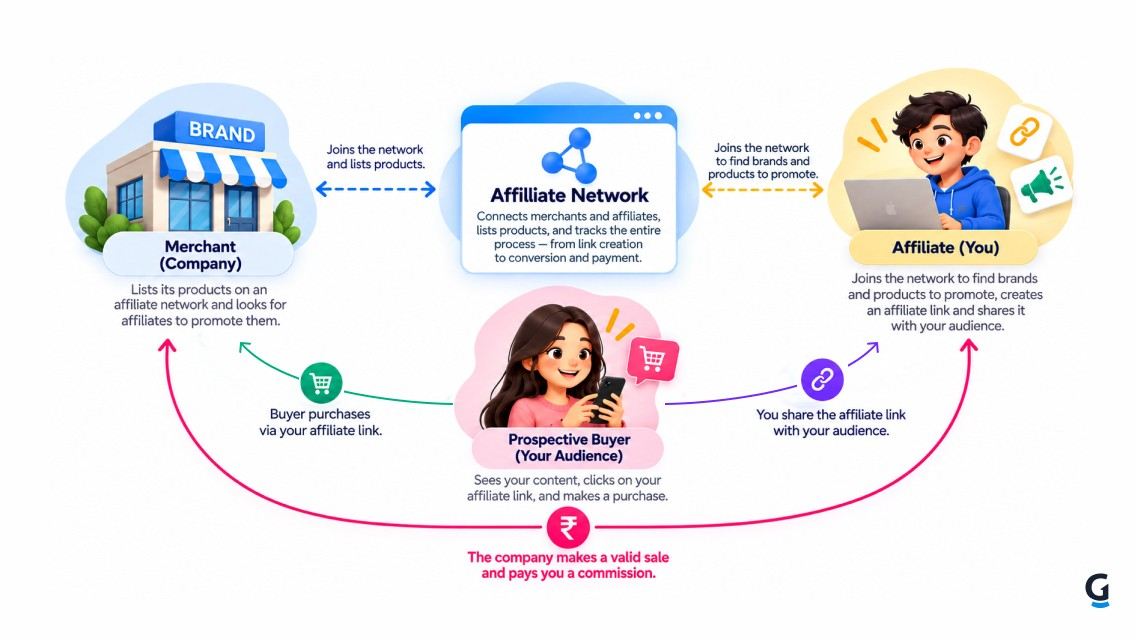
Here’s how the affiliate marketing process works:
- There is a company, AKA the merchant.
- There is you, or AKA the affiliate.
- There is your audience, AKA the prospective buyer.
- Company wants reach. Company wants promotion.
- You want to earn commissions.
- You promote the company and its product to your audience.
- You share the affiliate link.
- Your audience becomes buyers and purchases via your link.
- The company makes valid sales!
- The company pays you a commission for making that sale happen.
That’s the simple take on how affiliate marketing works.
The merchant uses an affiliate network to list its products and reach eligible affiliates. And an affiliate joins a network to find brands and products worth promoting. Both connect on an affiliate network and use it to keep track of the entire affiliate process: from link creation to conversion and payment.
Affiliate Marketing Types
Now that you know how affiliate marketing works, here are some types of affiliate marketing you need to know. We have divided it based on involvement, pay model, and partner type.
- Based on involvement, there are three types of affiliate marketing: unattached, related, and involved.
- Based on pay model, there are nine types of affiliate marketing: CPS, CPA, CPL, CPC, CPM, CPI, pay per call, revenue share, tiered
- And based on partner types, there are eight: Creators, social, video and live shopping, email, search, deal groups, link-sharing platforms, retailer creator programs
To get an in-depth idea about these types of affiliate marketing, you can read our guide on it, where every type is explained with an example, and how you can choose the right one that suits your goals.
How to Start Affiliate Marketing in India
Affiliate marketing is a cool way to create passive income; here is how you can get started:
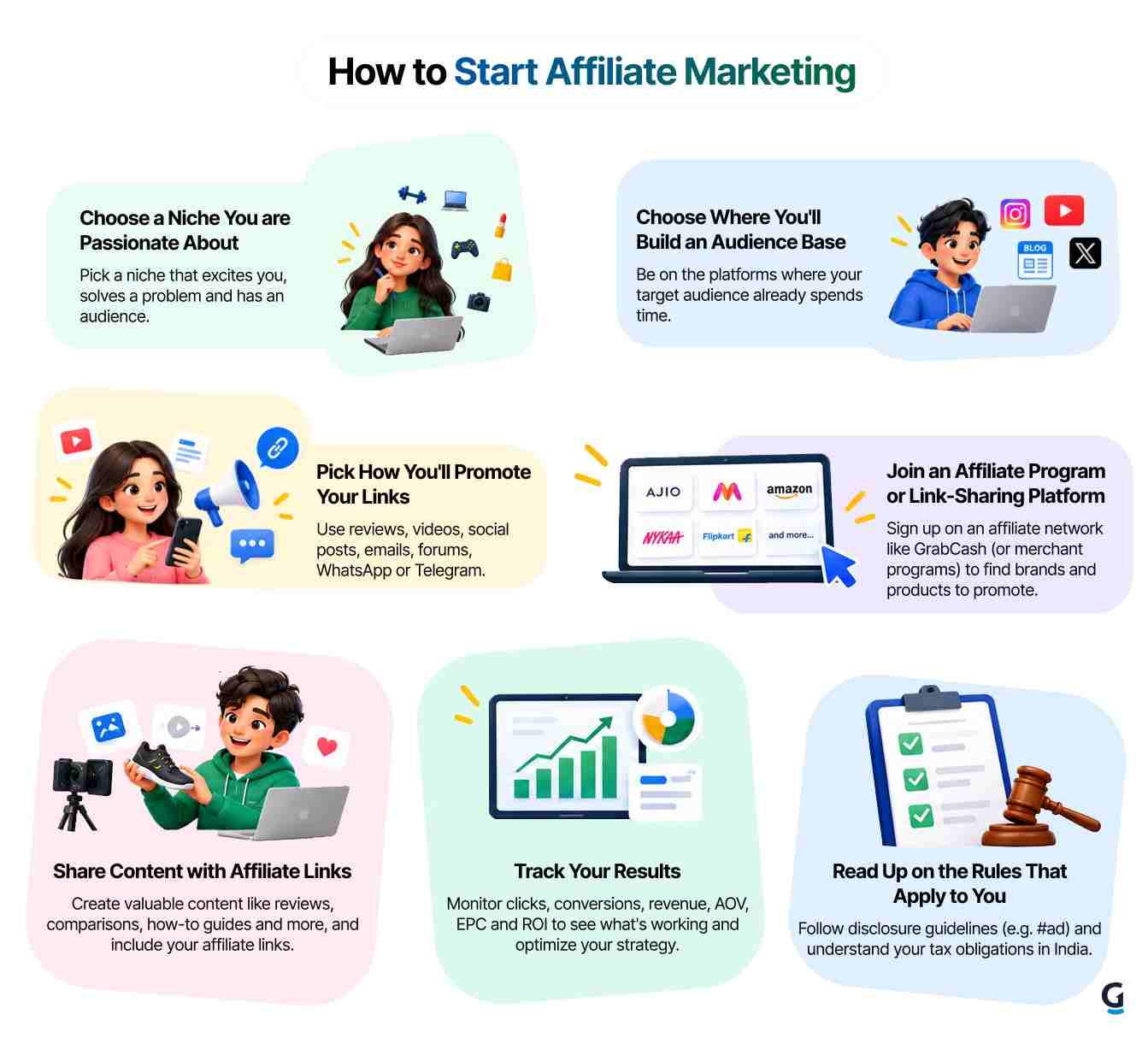
Choose a Niche You are Passionate about
Brands love interacting with affiliate marketers who have a loyal audience base. But how can you create that? You need to pick a niche where you are insanely good. While picking a niche, you need to focus on two things: passion and audience size. Your goal is to find a niche whose target audience is underserved and fill that gap. Ask yourself these questions to get a clear idea of what niche is best for you:
- What topics am I passionate about?
- What things am I good at?
- Can I create content around it?
- Is there a problem I can solve that others can’t?
- Are there enough people interested in the niche I am eyeing?
- Are there affiliate products available that fit this topic?
- Can I keep making content here for months without running dry?
Here are some hot niches you can try out right now: tech, gadgets, beauty, fashion, skincare, fitness, finance, luxury fashion, home decor, and food content. In the fitness niche, you can join the MuscleBlaze affiliate program; for fashion, you can join the AJIO affiliate program, and so on…
Choose Where You Want to Build an Audience Base
Pick the platform where your target audience already spends time, not the one that looks easiest. A fashion niche might be more relevant on Instagram; a tech-comparison niche might do better on YouTube or a blog. Start creating useful content on the platform that suits your niche. Post where your audience is, so there will be higher chances of conversions via your affiliate links.
A real example: Beauty influencer Malvika Sitlani started posting her makeup and beauty content in 2016. After building a loyal following, she went into an involved affiliate marketing partnership with Smashbox, promoting their limited range of lip products. Her YouTube channel and Instagram handle are interconnected; she uses both to partner with brands and increase their sales. Her growth came after she gained her audience’s trust.
Pick How You’ll Promote Your Links
Here are a few examples of how you can promote your affiliate links to your audience. Your job is to promote other brands and their products, and you can do that by using these various channels:
- You can naturally promote affiliate links through valuable, relevant content such as product reviews, comparisons, how-to guides, and even widgets on your blog. Focus on sharing honest recommendations rather than overloading your posts with affiliate links.
- Create YouTube videos showcasing unboxing videos or tutorials. You can also add relevant and clearly labeled affiliate links to the beginning of your video descriptions. Mention them within your videos to ensure transparency with your audience,
- Make social media posts on Instagram and Facebook, with links in captions, bios, or story stickers. You need to share authentic and relatable content that resonates with your audience and builds trust. Avoid spamming your audience.
- Send out email newsletters sharing exclusive deals, including affiliate links. You can promote the links directly by dedicating emails to specific offers or embed links naturally into valuable content.
- You can also promote the affiliate links on forums like Reddit and Quora by providing valuable, relevant answers and building trust with the community.
- Use communities on WhatsApp and Telegram where members expect deals and affiliate links.
Join an Affiliate Program or Link-Sharing Platform
You can apply to merchant programs directly, but approval can be slow, and tracking gets messy once you’re juggling several. A link-sharing platform solves both problems by giving you one dashboard for many merchants and no approval step. GrabCash is one such platform, and here’s how you can get started with GrabCash:
- Go to the GrabCash website.
- Click the “Login/Sign Up” button on the GrabCash homepage.
- Create an account using your mobile number or Google account.
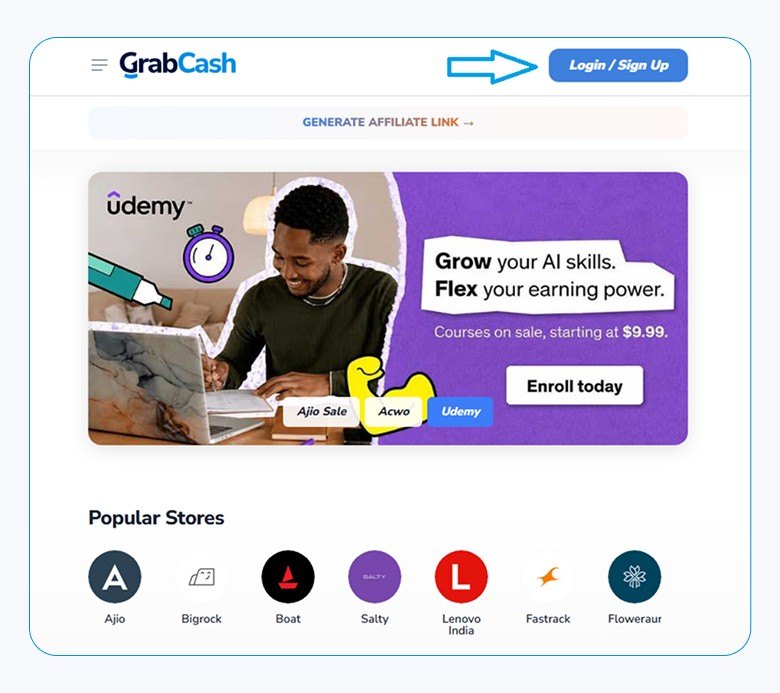
- Once logged in, browse thousands of deals and select one based on product, profit, or brand.
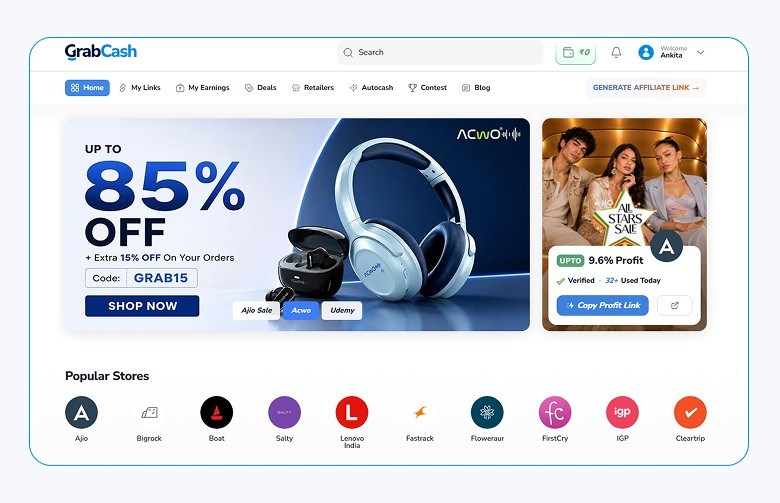
- You can convert a product link to a GrabCash affiliate link and share it on all your platforms, or you can select a profit link on GrabCash directly.
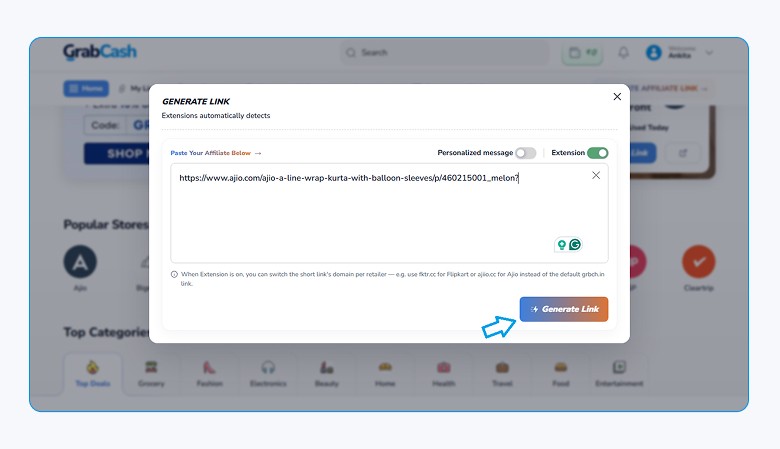
- To create an affiliate link. Copy the product link from the merchant website.
- Open GrabCash’s affiliate link generator. Paste the product link here and click “Generate Link”. You can use the “Extension” option to shorten your affiliate link as per the retailer as well.
- Then share your unique affiliate link on platforms like WhatsApp, Facebook, Instagram, or Reddit.
- When someone purchases through your link, you earn a commission, which is credited to your GrabCash account.
- Easily transfer your earnings directly to your bank account. Please note that you need a minimum of Rs.10 in your GrabCash account to withdraw your earnings.
GrabCash lets you manage all your affiliate deals in one place. You can track your sales and withdraw your commissions to your bank account whenever you want them. Just share links and earn; it’s that easy!
Share Content with Affiliate Links
Select brands and products that are relevant to your niche, and create content around them. Or you can create high-quality valuable content and then share the links that go with the content; you can do it either way. Here are some tips you can use while sharing your affiliate links.
- Repurpose your content and share it on all your platforms. This will save time because you don’t have to create content from scratch for each platform.
- Do not overlook SEO when creating your content. The better you optimize your content, the more people you will reach. So, create a solid SEO and content marketing strategy to double down on your audience.
- Improve your content-making skills so you can create attractive videos, designs, and blogs for your audience. Remember, visual appeal plays a huge role in decision-making. Audiences buy what looks good! So make sure your content looks good.
- Experiment with different content types like reviews, tutorials, comparison posts, and resource lists. Keep track of what’s working with your audience and create more of what’s working.
- Hop on trends. Social media lives off trends. So, being chronically online can help you identify trends and use them to reach more of your audience and promote your links.
Track Your Results
To ensure your affiliate marketing is working effectively, you need to keep track of a few elements. Doing this will help you identify areas of improvement and increase your chances of earning more.
- Check if your affiliate link works well and redirects to the correct product page with your affiliate ID on the product page.
- Analyze the links that are generating the most clicks and conversions. Check why they are performing well and try to replicate it for others.
- Track where the traffic is coming from mostly, whether it is social media, email, blogs, or other platforms, and revamp your efforts accordingly.
- If you want to do an in-depth analysis, you need to track these key metrics: total revenue from affiliate, conversion rate, AOV (average order value), EPC (earnings per click), and ROI.
Read Up on The Rules That Apply to You in India
Before you go beyond a few WhatsApp posts or start sharing links on your blogs, you need to get the legal basics straight. Here are two things every Indian affiliate should know, no matter what:
- Disclosure. ASCI’s influencer guidelines treat any commission-earning link or discount code as a “material connection.” That makes your post a promotional advertisement, and it needs a clear, visible disclosure such as “#ad” or “Affiliate link,” placed where people can actually see it. It should not be buried deep in your content.
- Tax. Once your affiliate income is real, it’s taxable as business or professional income, and GST registration typically applies once your annual income crosses ₹20 lakh (₹10 lakh in some states). See the full breakdown in “Affiliate Marketing Tax Basics in India” further down this guide.
Neither of these should scare you off from exploring affiliate marketing. But knowing about these intricacies means you won’t be caught off guard.
Why Become an Affiliate Marketer?
Beyond the earning potential, there are a few reasons affiliate marketing appeals to so many people, and it’s worth reading the real benefits of affiliate marketing in more depth if you’re still deciding whether it’s for you.
- The Ultimate Side Gig. You don’t need to quit your day job. Most affiliate marketers start in their free time, on weekends, or during lunch breaks to generate extra income alongside a full-time paycheck.
- Complete Independence. You call the shots. You choose what products to promote, which platforms to use, and how much time to invest, with no bosses or rigid corporate policies.
- No Inventory or Products Needed. Skip the hassles of product creation, warehousing, shipping, and returns. Your only role is connecting with your audience and earning commissions on their purchases.
- High ROI with Minimal Investment. You can launch with virtually zero upfront capital, often just by creating content on a free channel or setting up a low-cost website. For example, Grace Aberdeen, a popular affiliate marketer, only spends $30/month on her tools and website.
Best Affiliate Marketing Programs for Beginners
As a newbie, it can be difficult to find programs that are right for you. We have curated a list of affiliate programs that are beginner-friendly and easy to join.
| Affiliate Program | Commission Rate | Cookie Duration | Payment Duration | Sign-Up Process | Notes |
| Amazon Associates | 1%-20% (varies by product category) | 24 hours (cart additions, up to 90 days if it is still in cart | 60-day delay | Easy, quick approval but must make sales within 180 days of joining | Payment done via direct deposit or Amazon gift card |
| Rakuten Advertising | Varies on individual advertiser rates | Varies by the advertiser | Rakuten paid in 30 days and you get paid the following week | Straightforward approval process | Cashback platform with multiple commission structure like dynamic, coupon and multitouch |
| Shopify Affiliate Program | Up to $150 per plan referral | 30 days | Bi-weekly or custom threshold | Free and easy, but requires approval | Payment in USD via direct deposit or PayPal |
| AWIN | Varies by brand | Typically 30 days (but varies) | Varies by brand | Refundable $5 deposit along with a compliance check | Access to 25,000 advertisers |
| ClickBank | 1%-75% (but varies by product) | 60 days | Flexible ( weekly or bi-weekly ) | Very easy and no approval needed | More focused on digital products that offer high commission rates |
| eBay Partner Network | 1%-4% (varies by category) | 24 hours | Monthly | Simple, relatively easy approval | Commission is based on % of total sales. |
For a more in-depth comparison of these options including detailed commission rates, cookie windows, and step-by-step joining process, check out our full guide to the best affiliate programs in India.
All of the affiliate programs mentioned above are beginner-friendly, but the sign-up process and the approval process can sometimes feel overwhelming or time-consuming. That’s where an affiliate marketing platform like GrabCash comes in handy. You don’t need approval to join GrabCash. You can create an account within minutes and start earning.
How Do Affiliate Marketers Get Paid?
Before you start your journey as an affiliate marketer, you need to understand the various payment models in the industry. Here’s a look into how most of the affiliate marketers get paid.
How Much Do Affiliate Marketers Earn in India?
Affiliate marketing earning depends on the platforms an affiliate is using, their reach and its maturity. A beginner might earn somewhere between Rs. 1,000 to Rs. 15,000/month. While an experienced affiliate might earn Rs. 1,00,000/month or more. The earning potential will vary based on:
- Stage of the affiliate: beginner, intermediate, or established.
- Type of channel used for promotion: Instagram, WhatsApp, Telegram, YouTube, blog, etc.
- Maturity of the channel: How old that channel is
- Audience size and loyalty
- Niche and program type: fashion, fitness, electronics, tech, or others
- Commission rate and pay model
Your actual earnings depend on these things. There is no one benchmark number which an affiliate marketer earns. It differs based on the circumstances. Patience matters more than any single metric here.
Affiliate Marketing Tax Basics in India
Here is the thing most beginners skip: once your affiliate income becomes real, it’s taxable income in India, just like freelance or business income. A few basics worth knowing once the real money from affiliate marketing starts coming in:
- Affiliate earnings are generally treated as income from business or profession, and you’re responsible for reporting it.
- If your annual affiliate income crosses Rs. 20 lakh (Rs. 10 lakh in some states), GST registration typically applies.
- Keeping a separate bank account for affiliate income from day one makes tracking and filing easier down the line.
Once your monthly affiliate income becomes regular, you need to have a conversation with a CA to make sure you’re compliant and not leaving deductions on the table.
How to Be a Successful Affiliate Marketer
Affiliate marketing is more than just sharing links. It requires long-term commitment and hard work. Here is how you can become a successful affiliate marketer if you just lock in.

Avoid Shortcuts, Focus on Quality
Many beginners think the more traffic they can get, the more commission they will earn. They become greedy and resort to unethical means like bot traffic. However, this kind of traffic provides no value to the merchant, and honestly, it won’t convert. So rather than buying fake traffic, focus on getting quality traffic, and target audiences that are genuinely interested in your recommendations and will buy your suggested products.
Solve Real Audience Pain Points
Pay attention to what your audience is looking for, and religiously follow relevant discussions on Twitter, Facebook, Quora and Reddit. Spot trending questions and pain points and then offer genuine solutions. You can share the solution with your affiliate link so people will want to check it out. Remember, people are more likely to take your recommendations when they feel understood.
Focus on Conversion Rates over High Payouts
Newbie affiliate marketers get excited about affiliate programs with high payouts. However, you need to find ones that have a higher conversion rate so you can get a steady stream of commission. You can research programs with higher conversion rates even if the commission per sale is lower. A Rs.100,000 per sale commission may sound appealing, but if the conversion rate is 0.2%, it would require a huge number of clicks to make any money.
Build an Audience for the Long Haul
Try to build a loyal brand following. Grow your presence across all platforms like blogs, YouTube channels, or social media pages. Stay connected with the audience and build a community. Interact with them rather than pushing products. Rather than focusing more on how to make money off the audience, try creating quality content and attracting relevant audiences. This way, you can get high-converting leads for companies and build a long-term, recurring income.
Affiliate Marketing Mistakes Beginners Make That You Can Avoid
Even motivated beginners can slow their progress by making a handful of very common mistakes. Here are a few you should avoid:
- Promoting too many products. Signing up for every program scatters your focus. Stick to 2 to 3 highly relevant products that fit your niche to maintain audience trust.
- Chasing commissions over fit. High payouts mean nothing if the product doesn’t resonate. Prioritize audience alignment and credibility over high commission rates.
- Ignoring SEO. Social media algorithms are unpredictable. Optimize your blog or YouTube content with basic on-page SEO to build consistent, compounding organic traffic.
- Hiding affiliate disclosures. Failing to disclose links violates ASCI guidelines in India and breaks audience trust. Include a simple, transparent disclosure line on your content.
- Giving up too early. Meaningful commissions take time. Treat the first six months as a learning phase and focus on consistency rather than immediate financial results.
Tools That Make Affiliate Marketing Easier
Having the right tools makes your affiliate marketing workflow faster, more organized, and easier to scale. Here are the key categories and what works well in each:
-
- Link Management. Managing multiple affiliate links across platforms gets messy fast. Tools like Pretty Links (for WordPress users) and Bitly let you shorten, brand, and track your affiliate links in one place.
- Content Creation. Canva for graphics, Grammarly for writing, CapCut for short-form video. Other popular tools to try: Adobe Express, InVideo, Trello, Notion and of course ChatGPT.
- SEO and Keyword Research. You do not need expensive tools to get started with SEO. Google Search Console is free and shows you exactly which search queries are bringing people to your content. Other tools include Ubersuggest, Ahrefs and SEMrush.
- Analytics. Google Analytics remains the standard for tracking website traffic, user behavior, and conversion paths. Pair it with the analytics dashboards built into your affiliate platforms (like GrabCash) to get a full picture of what content is driving sales and what is just driving clicks.
- Email Marketing. If you plan to build an email list and you should, tools like Mailchimp (free up to 500 subscribers) or Brevo (formerly Sendinblue) let you send newsletters, set up automated sequences, and embed affiliate links directly into your emails.
Where Affiliate Marketing is Heading in 2026
Two major changes should matter to anyone starting Affiliate Marketing in India now. First, video and live shopping are taking a growing share of affiliate activity: on September 24, 2026, Google announced that Amazon, AJIO, Meesho, Snapdeal and Tata CLiQ are joining YouTube Shopping’s affiliate program in India, alongside Flipkart, Myntra, Nykaa, Purplle, Shopsy and Tira. This means as a creator on YouTube, you can tag products from these platforms directly in your videos, Shorts, and livestreams and earn commissions when viewers buy them.
Second, AI tools are changing how people research purchases. AI overviews, conversations with ChatGPT and other AI chatbots are changing how people reach a decision. AI values first-hand experience and subjectivity more. So, if you are writing a boring X vs Y article then you might not do so well, but pitching in your two cents about which one is better and why can get you cited in an AI overview. So, stay updated about the ongoing changes around search engines and adapt with it.
Your Next Step
While affiliate marketing may seem like an interesting passive income stream, it needs your time and effort. You need to create relevant content that convinces the target audience to make a purchase. Pick one niche, one channel, and one merchant. Build an audience. Post regularly. Give it 30 days before you judge the results. If you want to start without approvals or a website, create your GrabCash links here. Keep putting in the work and go grab that cash!
FAQs
What does an affiliate marketer actually do?
An affiliate marketer shares a unique tracking link to a product or service on their platform, whether that’s a blog, YouTube channel, Instagram page or a WhatsApp group, and earns a commission whenever someone completes a purchase or another qualifying action through that link.
Is affiliate marketing legal in India?
Yes. There’s no law against it, provided you disclose paid or commission-earning links clearly, in line with ASCI’s guidelines, and follow fair business practices.
How long does it take to make money with affiliate marketing?
Most people see their first commission within a few weeks to a few months of consistent sharing, but a reliable monthly income usually takes 6 to 12 months to build.
What’s the difference between affiliate marketing and influencer marketing?
Affiliate marketing pays you only when a specific action happens, usually a sale. Influencer marketing typically pays a flat fee for content or exposure, regardless of sales. Many creators do both.
Do I have to pay tax on affiliate income in India?
Yes. It’s treated as business or professional income, and GST registration typically applies once your annual income crosses ₹20 lakh (₹10 lakh in some states). Talk to a CA once your income becomes regular.
Which affiliate program is best for a complete beginner in India?
It depends on your niche. But as a beginner, you can get started with a link-sharing platform like GrabCash. For a global, single-merchant option, Amazon Associates is a popular and reliable option.
Do I need to disclose affiliate links in India?
Yes. ASCI treats a commission-earning link or discount code as a material connection which makes the content promotional. That means it needs clear disclosure in your content such as “#ad” or “Affiliate link”. It needs to be placed where people can actually see it.