

| Quick answer: The average affiliate link CTR sits between 0.5% and 1.5% in 2026. But that number now depends heavily on whether AI Overviews appear on the search results. Organic CTR drops 34-61% when they do. Anything above 1% still counts as strong; above 3% is exceptional for niche, high-intent content. |
Affiliate marketing keeps growing, but the rules for earning clicks changed faster in the last 12 months than in the previous five years combined. If you’re still benchmarking your CTR against previous years’ numbers, you’re comparing yourself to a search landscape that doesn’t exist anymore.
CTR shows how often someone actually clicks your affiliate link after seeing it. It’s the metric that separates content people skim from content people act on. And in 2026, it’s being reshaped by one force above all others: AI-generated answers sitting on top of the search results you used to rank for.
This piece breaks down where CTR stands today, why your numbers might be dropping even if your rankings haven’t moved, and what to actually do about it.
What is Affiliate Click-Through Rate?
CTR measures how many people click your affiliate link out of everyone who saw it.
| Formula: CTR = (Clicks ÷ Impressions) × 100 |
For Example: Imagine you write a blog about your favorite kitchen gadgets and include a few links where readers can buy them. Out of 1,000 people who visit your blog, if 20 people click those links, that’s what we call a click‑through rate (CTR).
A high CTR tells you your content, placement, and call-to-action are working together. A low one usually points to a mismatch between what you promised in the headline and what the reader found on the page, or a link buried where nobody scrolls.
Key Affiliate CTR Statistics – Editor’s Pick
- Google Overviews appear for 48% of US search queries.
- Organic CTR on AI Overview queries fell from a 1.76% baseline to a low of 0.61% in late 2025 before rebounding 85% to reach 2.4% by February 2026.
- A good CTR in affiliate marketing typically falls between 0.5% and 1%, with anything above 1% considered excellent.
- Affiliate marketing drives around 5 billion clicks globally, accounting for 16% of all e-commerce sales in North America.
- A healthy click-through rate (CTR) typically ranges from 1% to 5%.
- By 2027, mobile affiliate marketing is projected to account for nearly two-thirds (65%) of all affiliate clicks.
- Websites with high ratings can see a 28% increase in click-through rates (CTR).
- Twitter ads have the highest average CTR at 2.00%, while LinkedIn has the lowest at 0.06%.
Why Your CTR Might Be Falling Even Though Your Content Didn’t Change
Google’s AI Overviews now appear on roughly 48% of US search queries, up sharply from just over a year ago. Broader keyword analyses by Ahrefs show that when one shows up above your ranking, organic CTR drops 34% to 61% depending on the study and query type.
Longitudinal industry research from Seer Interactive indicates that organic CTR on AI Overview queries experienced an initial collapse, falling from a 1.76% baseline down to a floor of 0.61% in late 2025, before seeing an 85% rebound to reach 2.4% by February 2026.
The categories hit hardest are exactly the ones affiliate marketers rely on: how-to content, product comparisons, and general explainers. Healthcare-adjacent queries trigger an AI Overview 60.7% of the time; home and garden content, 50.4%.
Here’s the part worth paying attention to: CTR on queries without an AI Overview has actually been climbing, from around 2.8% in early 2025 to 3.8% by February 2026. Search is splitting into two lanes, one where AI answers the question directly and traffic dries up, and one where it doesn’t, and clicks are getting more valuable, not less.
| Metric | Value |
| CTR with AI Overview present (2025) | 0.61% |
| CTR with AI Overview present (Feb 2026) | 2.4% |
| CTR without AI Overview present | 1.62% – 3.8% |
| Position-1 CTR drop when AIO present | 34.5% – 58% |
| Brands cited inside AI Overviews vs uncited | +35% organic clicks, +91% paid clicks |
| AI Overview appearance rate (US queries) | ~48% |
What this means practically: If your affiliate content answers a question fully in the first two sentences, Google’s AI Overview can lift that answer and satisfy the searcher without a click. The fix isn’t shorter content; it’s content structured so the AI Overview cites you as the source, since cited brands see a 35% CTR lift even on the clicks that remain. That means clear definitions early, original data or stats Google can’t get elsewhere, and a reason to click through beyond the basic answer, like a comparison table, calculator, or the specific deals.
Source: Ahrefs Keyword Analysis from The Stacc, Seer Interactive Longitudinal Data, Seer Interactive Study
CTR Conversion Tactics
Compelling calls-to-action (CTAs) have a high impact on CTR and are easy to apply, making them a quick win for any campaign. On the other hand, strategic link placement ensures your links appear where users are most likely to click, providing a medium boost with low difficulty.
In summary, improving CTR is about understanding your audience and choosing the right strategies that connect with them. Some tactics may take more time or testing, but each plays a role in building trust and driving engagement.
Here is a table displaying tactics to increase your CTR.
| Tactic | Impact on CTR | Implementation Difficulty |
| Compelling CTAs | High | Low |
| A/B Testing | Medium | Medium |
| Landing page optimization | Very High | High |
| Strategic Link Placement | Medium | Low |
| Audience Targeting | High | Medium |
Source: Alexanderjarvis
Calculating Conversion Metrics
To improve your affiliate marketing performance, it’s important to first understand how to calculate your Click-Through Rate (CTR) accurately. The formula is simple:
CTR = (Number of Clicks / Number of Impressions) × 100
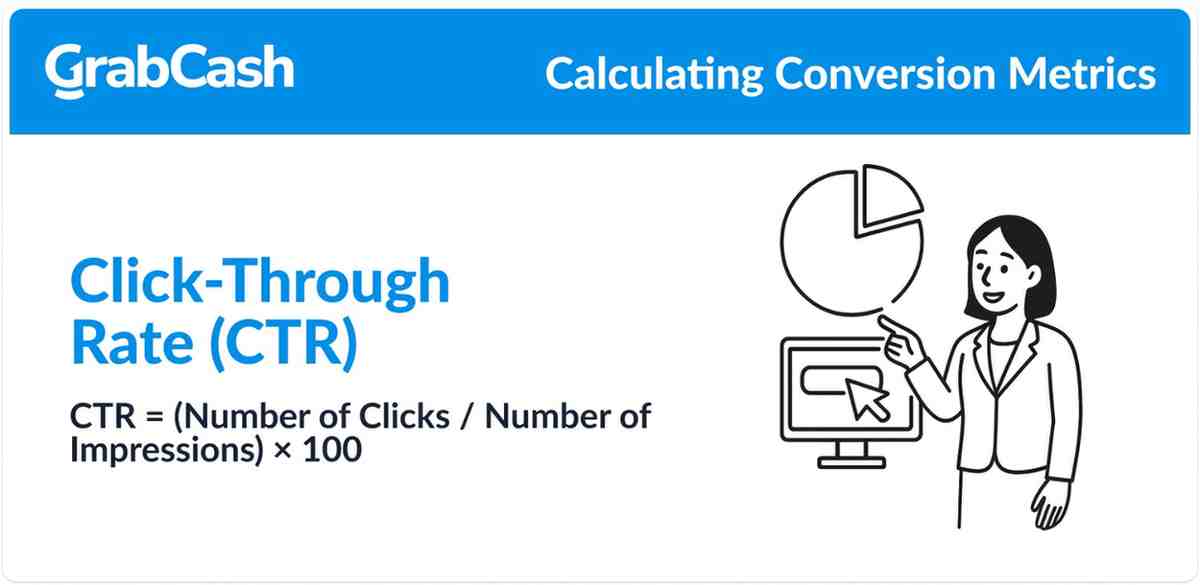
For Example: If your affiliate link gets 300 clicks from 10,000 impressions, your CTR would be 3%, which is considered a healthy average in affiliate marketing.
- Healthy performance range: A CTR between 1% and 5% generally indicates a strong and effective campaign.
- Below 1%: May signal issues with your content quality, targeting, or link placement, suggesting it’s time to optimize your approach.
- Above 5%: Could mean your ads are highly targeted and performing exceptionally well, or that you’re focusing on a narrow, niche audience with higher engagement potential.
Mobile vs Desktop Affiliate CTR Performance
Mobile users are more likely to click on affiliate links, with an average CTR of 1.5% compared to 0.9% on desktop. This shows that mobile-optimized campaigns can attract nearly double the clicks.
However, desktop users convert at a higher rate, with a 2.9% conversion rate versus 1.6% on mobile. This indicates that while desktop traffic might generate fewer clicks, those clicks are more likely to result in actual sales.
Overall, this table shows that mobile excels in driving clicks and engagement, while desktop delivers stronger conversions.
| Category | Mobile | Desktop | Insights |
| Average CTR | 1.5% | 0.9% | Mobile drives nearly double the clicks compared to desktop. |
| Conversion Rate | 1.6% | 2.9% | Desktop users convert at almost twice the rate of mobile users. |
| Target CTR for Success | 3%+ (Optimized Campaigns) | 1%+ | Aim above 1% overall; mobile can outperform when optimized. |
| Email Campaign CTR (Specific Niches) | Up to 5.13% | Around 3.2% | Lifestyle and hobby niches perform best on mobile email. |
| Share of Digital Ad Clicks | 60% – 70% | 30% – 40% | Most ad clicks now come from mobile devices. |
| Ad-Blocker Usage | 7% of users | 27% of users | Ad-blockers are more common on desktop, affecting ad visibility. |
| Video Ad Engagement | 2 to 3x more engaging | Less engaging | Mobile video ads perform significantly better. |
| E-commerce Trend | The majority of online shopping happens on mobile | Smaller Share | Growth in mobile commerce boosts mobile ad performance. |
Source: Alexanderjarvis
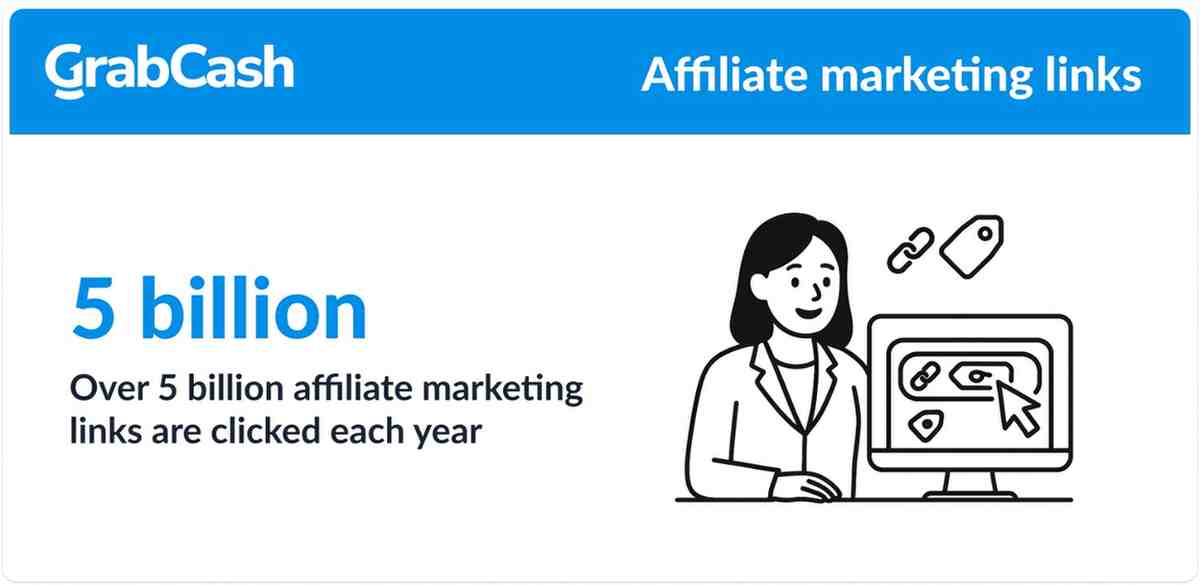
Every year, more than 5 billion affiliate marketing links are clicked.
More than 5 billion affiliate marketing links are clicked each year. This number shows how consumers increasingly rely on recommendations from influencers, bloggers, and content creators to make purchasing decisions.
Source: wecantrack
Ways to Optimize Conversion Rates in Affiliate Programs
Optimizing affiliate programs can dramatically improve conversion rates when the right strategies are applied. Speeding up your website alone can increase engagement by 40%, keeping visitors from bouncing and encouraging more clicks.
Producing high-quality, relevant content drives up to 55% more engagement, as users trust and interact more with valuable information.
Overall, these strategies show that improving affiliate conversions isn’t about a single tactic. It’s about a holistic approach. By combining these strategies, affiliates can maximize clicks, engagement, and conversions, turning their campaigns into consistent and profitable revenue generators.
| Optimization Strategy | Impact (%) |
| Enhance Website Load Speed | 40% |
| Focus on High-Quality, Relevant Content | 55% |
| Optimize for Mobile Devices | 45% |
| Improve User Experience (UX) Design | 50% |
| Use Strong, Clear Call-to-Actions (CTAs) | 60% |
| Leverage Data Analytics for Insights | 35% |
| Personalize Affiliate Marketing Efforts | 48% |
| A/B Test Landing Pages and Offers | 38% |
Source: wecantrack
Best Practices for Affiliate CTR Success
For New Affiliates
- Start with thorough niche research to identify both demand and opportunity.
- Build audience first, monetization second. Authentic audiences generate higher CTR and conversion.
- Focus on content quality over quantity.
- Track your metrics, understand your baseline CTR, and set improvement targets.
- Join programs aligned with your audience rather than the most lucrative commissions.
- Experiment with various link positions, CTAs, and messages to see which generates the best response.
For Established Affiliate Programs
- Provide affiliates with quality marketing materials, including banners, product images, and copy.
- Offer competitive commission structures to attract top-performing affiliates.
- Support affiliates with training on product features and target audience optimization.
- Monitor performance data and provide affiliates with actionable insights.
- Create tiered incentives rewarding top performers and encouraging others to improve.
- Implement robust fraud detection while maintaining affiliate trust.
Source: Alexanderjarvis
Place affiliate links strategically to increase visibility and click-through rates
Placing affiliate links strategically directly impacts visibility and click-through rates. Links in the first paragraphs grab immediate attention, while visual elements like buttons or highlighted text make them stand out.
Contextual integration helps links feel natural and relevant within the content, reducing the perception of spam and building trust. By combining these strategies, affiliate marketers can ensure their links are both visible and relevant, maximizing engagement and improving overall campaign performance.
| Placement Strategy | Impact on CTR |
| First paragraphs | Highest visibility, captures initial attention |
| Visual elements | Buttons/highlighted text increase notice |
| Contextual integration | Creates relevance, reduces “spam” feeling |
| A/B tested locations | Data-driven placement optimization |
| Narrative flow | Natural integration improves user experience |
Source: Alexanderjarvis
How Page Speed Impacts Affiliate CTR and Conversion Rates
Page speed plays a critical role in affiliate CTR and user engagement. Even the most visually appealing e-commerce pages can lose potential conversions if they take too long to load, as 70% of users abandon a page that takes more than three seconds.
Optimizing with image compression, code minimization, CDNs, and removing unused scripts can boost CTR, improve user experience, and increase visibility. Fast-loading pages are essential for maximizing clicks and conversions.
| Speed Issue | Impact on CTR | Solution | Benefits |
| 1-second delay | 7% drop in conversions | Image optimization | Higher engagement |
| Slow mobile loading | Decreased visibility | Code minimization | Better SEO ranking |
| Poor server response | Frustrated visitors | Content Delivery Networks | Wider audience reach |
| Heavy page elements | Reduced user experience | Remove unused scripts | Immediate CTR boost |
Source: Alexanderjarvis
Optimizing Landing Pages to Boost Affiliate CTR
The quality of your landing page is a key factor in the success of affiliate marketing campaigns, directly influencing whether visitors click your links or leave. A high-converting landing page turns casual browsers into buyers, bridging the gap between interest and action.
To create landing pages that convert effectively:
- Ensure your landing page delivers exactly what your ads promise, as consistency can lower bounce rates by up to 70%.
- Use clear and persuasive calls-to-action to guide visitors, which can increase CTR by up to 80%.
- Optimize your pages for mobile devices, since more than half of your traffic comes from smartphones.
- Speed up your page load times, as even a one-second delay can reduce conversions by 7%.
Source: Wecantrack
How to Increase Affiliate CTR with Various Link Types
Each link type serves a specific purpose and performs differently depending on placement, format, and audience engagement.
- Text links work best when naturally included within content, such as in articles or product reviews, and typically achieve a CTR of 1-3%.
- Banner images are ideal for visually appealing products, capturing attention through graphics, but usually have a slightly lower CTR of 0.5-2%.
- Button CTAs are designed to drive direct conversions, offering the highest CTR at 3-7% when placed strategically.
- Product widgets allow multiple items to be displayed at once, giving visitors options and generating a CTR of 2-4%.
Overall, testing different formats and placements can help identify what drives the most clicks, ensuring higher engagement and improved affiliate revenue.
| Link Type | Best Used For | Average CTR |
| Text Links | In-content mentions | 1-3% |
| Banner Images | Visual products | 0.5-2% |
| Button CTAs | Direct conversions | 3-7% |
| Product Widgets | Multiple items | 2-4% |
Source: Alexanderjarvis
Average CTR Benchmarks by Industry
Across the board, search ads outperform display ads, with CTRs often several times higher. Arts & Entertainment leads with a search CTR of 11.43 percent, while Travel has a CTR of 9.19 percent and Sports & Recreation has 8.82 percent, showing strong engagement.
Industries like Home and Home Improvement, with 4.62 percent, and Attorneys and Legal Services, with 4.24 percent, have lower search CTRs, indicating that capturing user attention can be more challenging in these sectors.
Overall, understanding these CTR benchmarks is crucial for marketers aiming to optimize their campaigns.
| Industry | Average CTR (Search) | Average CTR (Display) |
| Travel | 9.19% | 0.47% |
| Sports & Recreations | 8.82% | 0.51% |
| E-commerce | 5.50% | 0.51% |
| Restaurants & Food | 7.60% | 0.47% |
| Real Estate | 8.55% | 1.08% |
| Industrial & Commercial | 5.61% | 0.46% |
| Home & Home Improvement | 4.62% | 0.49% |
| Health & Fitness | 6.15% | 0.59% |
| Finance & Insurance | 5.70% | 0.52% |
| Education & Instruction | 6.17% | 0.53% |
| Career & Employment | 5.93% | 0.59% |
| B2B | 5.17% | 0.46% |
| Beauty & Personal Care | 5.92% | 0.72% |
| Automotive | 5.65% | 0.60% |
| Attorneys & Legal Services | 4.24% | 0.59% |
| Arts & Entertainment | 11.43% | 0.51% |
Source: cxl
Google Click Through Rate Statistics
Google Search rankings play a major role in driving traffic, not just for websites but also for affiliate marketers. Users are far more likely to click on the top organic results or featured snippets, which means affiliates who appear in these positions can generate significantly more clicks and potential revenue.
Here are a few key Google CTR statistics that every affiliate marketer should know:
- Over two-thirds of clicks on Google Search go to the top 3 organic results.
- The featured snippet that replaces the #1 organic result achieves the highest CTR at 42.9%.
- On average, the #1 organic search result receives 19 times more clicks than the top paid search ad.
- Among paid ads, the top paid search result has a CTR 40% higher than the #2 paid ad.
- The #1 organic result gets more clicks than results #3 through #10 combined.
Source: Alexanderjarvis
Affiliate Click-Through Rate For Brands
- On average, an influencer’s affiliate link gets a 2.5% click-through rate (CTR).
- Twitter ads generally get the highest CTR at around 2%, while LinkedIn ads have the lowest, at just 0.06%.
- Facebook ads get about 0.72% CTR, but video ads perform much better, over 2%, even surpassing Twitter’s average of 2.21%.
Source: WeCanTrack
Affiliate Click-Through and Conversion Insights: What Really Works
Target the Right Audience to Boost Conversions
- Affiliates who focus on highly relevant audiences can achieve conversion rates of 5% to 10%, far above the industry average.
- Top-performing affiliates consistently see conversion rates between 5% and 10% by strategically engaging the right audience.
Product Reviews and Influencers Drive More Clicks
- Around 60% of online shoppers click affiliate links when researching product reviews, and nearly 30% purchase within 24 hours.
- Influencers with highly engaged followers can achieve conversion rates of 4% to 8%, often outperforming traditional affiliate methods.
- Affiliate links in product reviews convert better than generic content, averaging 2.3% CTR.
- Affiliate links shared by influencers typically achieve a 2.5% CTR. This shows their ability to drive strong audience engagement.
Engage Your Social Media Audience for Higher Conversions
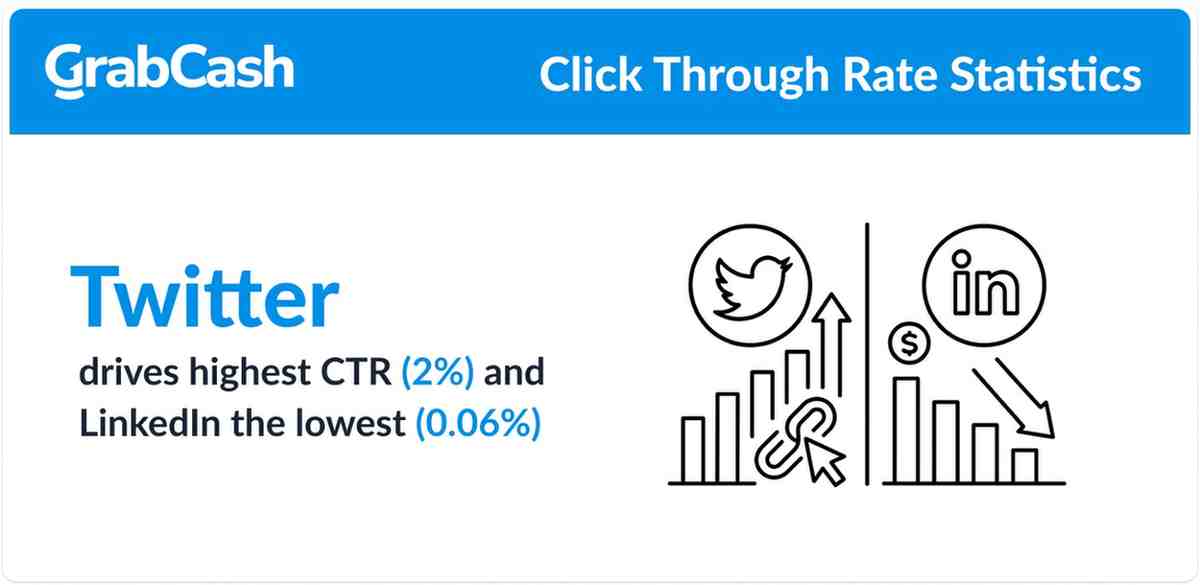
- On social media, Twitter ads see the highest click-through rate at 2.0%, while LinkedIn ads have the lowest at 0.06%.
- Facebook link ads average a 0.72% CTR, but video ads perform much better, exceeding 2% and even surpassing Twitter’s average.
Mobile and Video Are Game Changers
- Mobile-optimized affiliate websites see 64% higher conversion rates than non-optimized sites.
- Using video content can boost affiliate conversion rates by 34% compared to text-only content
Quality Content and Relevant Products Win
- High-quality, relevant content can increase conversions by up to five times compared to generic or poorly written content.
- Promoting highly relevant products can increase conversion rates by up to 80%.
Source: wecantrack
Affiliate Marketing Statistics
- The global affiliate marketing industry is worth over $18.5 billion.
- Brands earn an average of $15 ROI for every $1 spent on affiliate marketing.
- 27.8% of brands use blogs as their main affiliate channel.
- 57% of affiliate marketers are from the US, 10% from Canada, and 2% from India.
- 54% of affiliate marketers are male, while 43% are female.
- Over 50% of affiliate traffic comes from mobile devices.
- 81% of brands run affiliate marketing programs.
Source: affiliatestatistics
Key Takeaways
Understanding affiliate click-through rates (CTR) is crucial for marketers and brands aiming to optimize their campaigns. While a good CTR can vary by industry, anything between 1–3% is generally considered solid, with higher rates reflecting stronger audience interest and engagement. By understanding and analyzing CTR trends, brands can optimize their strategies, focus on high-performing channels, and create campaigns that truly resonate with users.
FAQs
What is the click-through rate in affiliate marketing?
Click-through rate (CTR) measures how often people click on your affiliate links, ads, or listings compared to how many times they see them. It’s calculated as: clicks ÷ impressions × 100 = CTR. For example, if 5 people click your link out of 100 views, your CTR is 5%. CTR helps you understand how engaging and effective your content is.
Is a CTR of 2% good?
Yes, a 2% CTR is generally considered good. It shows that your audience is noticing and engaging with your links.
What is a good CTR rate?
In affiliate marketing, a typical CTR ranges from 0.5% to 1%. Anything above 1% is considered excellent, indicating that your content and placement are effectively attracting clicks.
Is a 4% CTR good?
Yes, a 4% CTR is usually seen as strong. On platforms like YouTube or Google Search Ads, this falls in the “average to good” range. Depending on your niche and content, it could even be excellent. For context, 2% to 4% is average, while 4% to 10% is often considered good to excellent for YouTube, and 4% to 5%+ is strong for Google Search Ads.
Why did my affiliate CTR drop even though my rankings stayed the same?
An AI Overview is most likely now appearing on that query. Organic CTR falls 34-61% when one does, even at the same ranking position.
Does getting cited in an AI Overview actually help?
Yes. Brands cited inside an AI Overview see about 35% more organic clicks and 91% more paid clicks than uncited competitors on the same query.
Is mobile or desktop better for affiliate conversions?
Mobile generates more clicks (1.5% CTR vs 0.9%), but desktop converts those clicks into sales at almost double the rate.