

As of 2026, the affiliate marketing market is valued at $28 billion and is projected to grow at a 15% CAGR, reaching $56.3 billion by 2031. This rapid rise is fueled by the ongoing boom in eCommerce, with more brands turning to performance-based partnerships as a cost-efficient way to acquire customers.
India mirrors this global momentum, with affiliate spending growing from $331 million in 2023 to an expected $465 million in 2026, now contributing around 10% to 12% of digital marketing budgets. In North America, affiliates already drive 16% of total eCommerce orders, showing just how integral this model has become to online retail.
In this blog, we’ll dive into the latest affiliate marketing statistics covering market size, earnings, traffic sources, ROI, and top-performing niches, to give you a complete picture of where the industry stands today and the opportunities ahead.
Global Affiliate Marketing Industry Size
The affiliate marketing industry is valued at $28 billion as of 2026. The market is set to grow at a CAGR of 15% till 2031, reaching a valuation of $56.3 billion.
| Year | Market Size |
| 2024 | $21.2 billion |
| 2025 | $24.3 billion |
| 2026 | $28 billion |
| 2027 | $32.2 billion |
| 2028 | $37 billion |
| 2029 | $42.6 billion |
| 2030 | $49 billion |
| 2031 | $56.3 billion |
The growth of the affiliate marketing industry is closely tied to the rapid expansion of eCommerce worldwide and in India. As online shopping continues to attract millions of new customers each year, brands are under pressure to find cost-effective ways to reach them. Affiliate marketing provides a performance-driven model where businesses only pay for results, making it one of the most efficient channels for customer acquisition.
As long as eCommerce keeps growing, affiliate marketing will continue to gain momentum as an essential growth lever for businesses of all sizes.
Source: VMM.
Affiliate Market Size in India
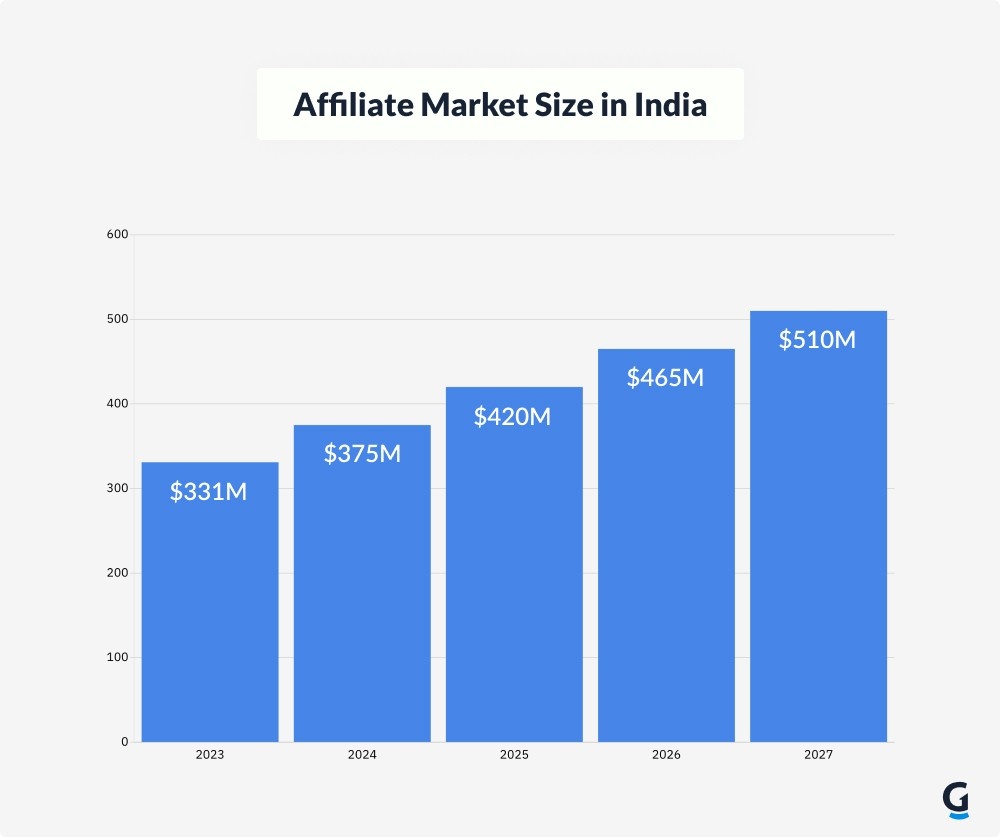
India is currently the fastest-growing major economy in the world, which creates a strong outlook for affiliate marketing in the country. Affiliate marketing in India is worth $465 million in 2026 and is projected to cross the $500 million mark by 2027.
| Year | Affiliate Marketing Industry Size In India |
| 2023 | $331 million |
| 2024 | $375 million |
| 2025 | $420 million |
| 2026 | $465 million |
| 2027 | $510 million |
Based on primary interviews, supported by secondary research, affiliate marketing contributes about 10% to 12% of digital marketing spend by companies in India. In more mature markets, however, the share is higher, averaging around 15%.
We are a growing affiliate provider ourselves in India. Sign Up Today!
Source: IAMAI.
Affiliate’s Share in Total Ecommerce Orders in The USA and Canada
16% of the ecommerce orders in the United States and Canada come from affiliates. It’s striking to note that as of 2026, nearly 8 out of 10 people in the U.S. shop online, and most of them do their research online while buying, which involves YouTube reviews, reels, and more.
With this number set to rise in the coming years, brands will rely even more on influencers and content creators to reach these audiences, ultimately driving a larger share of affiliate-driven orders.
Building Consumer Trust in Indian E-Commerce
Indian consumers are gradually becoming more open to online shopping, though there’s still room for stronger trust in digital advertising. Currently, 52% of Indian shoppers trust online ads, slightly below the global average of 61%.
This shows a promising base that can be further strengthened with better transparency, customer experiences, and brand credibility. Similarly, while the average affiliate marketing conversion rate in India is around 2% compared to the global 4%, it highlights the untapped potential that businesses can tap into as consumer trust and digital adoption continue to grow.
Source: IAMAI.
AI Adoption Among Affiliate Marketers
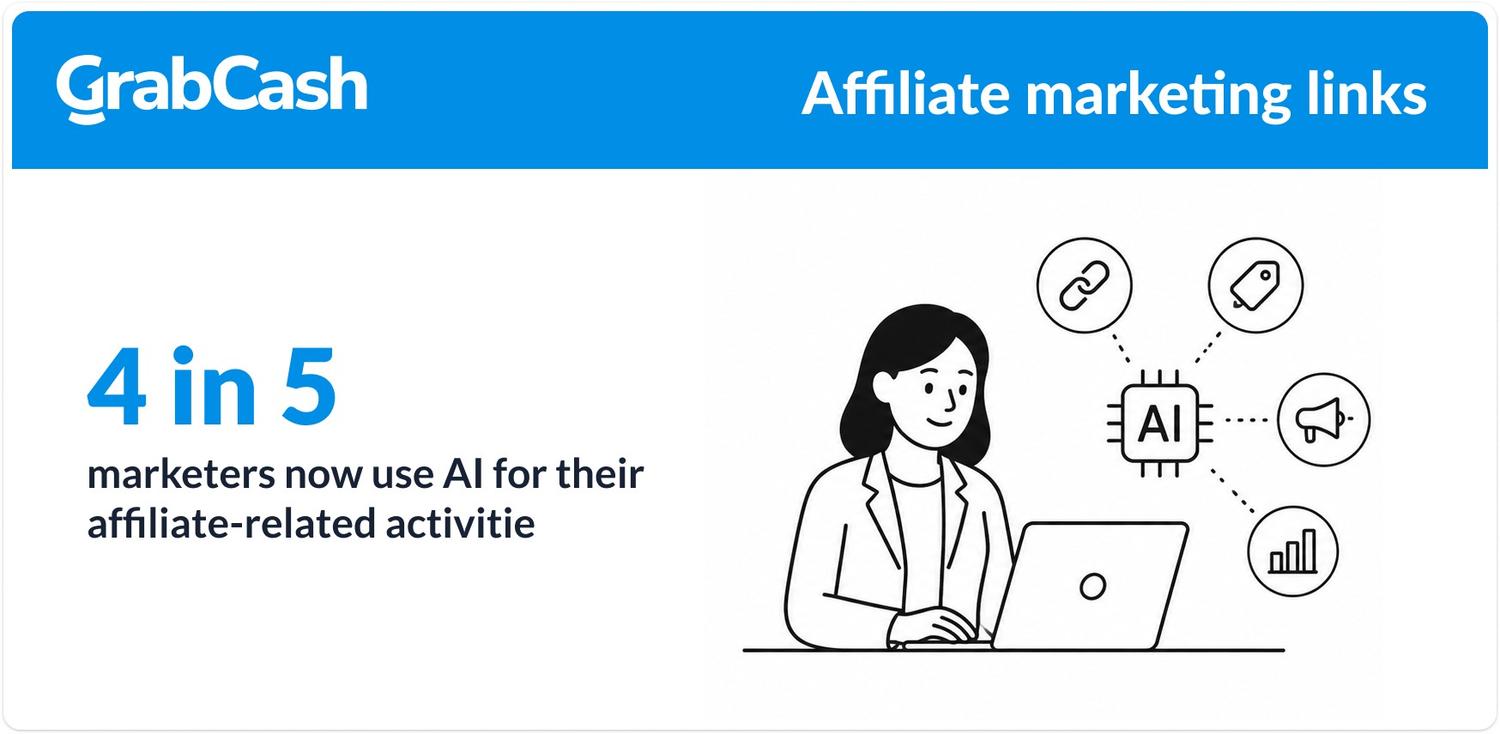
Nearly 4 in 5 affiliate marketers, around 79.3%, now use AI-driven tools for content creation, making artificial intelligence one of the fastest-adopted technologies in the industry.
As more shoppers turn to AI chat tools and AI-powered search for product research, early industry data suggests that visitors arriving through these AI referrals convert at noticeably higher rates than traditional search visitors, converting at around 1.66% compared to 0.15% for regular search traffic. The volume is still small, but the quality of these visitors is hard to ignore.
At the same time, this shift carries risk for affiliates who depend on a single channel. About 25.1% of affiliate marketers report being negatively affected by Google search algorithm updates, which is one in four. With AI Overviews and chat-based answers reshaping search behavior, diversifying across email, social media, and AI-visible content is quickly becoming a survival strategy rather than an option.
Source: Authority Hacker.
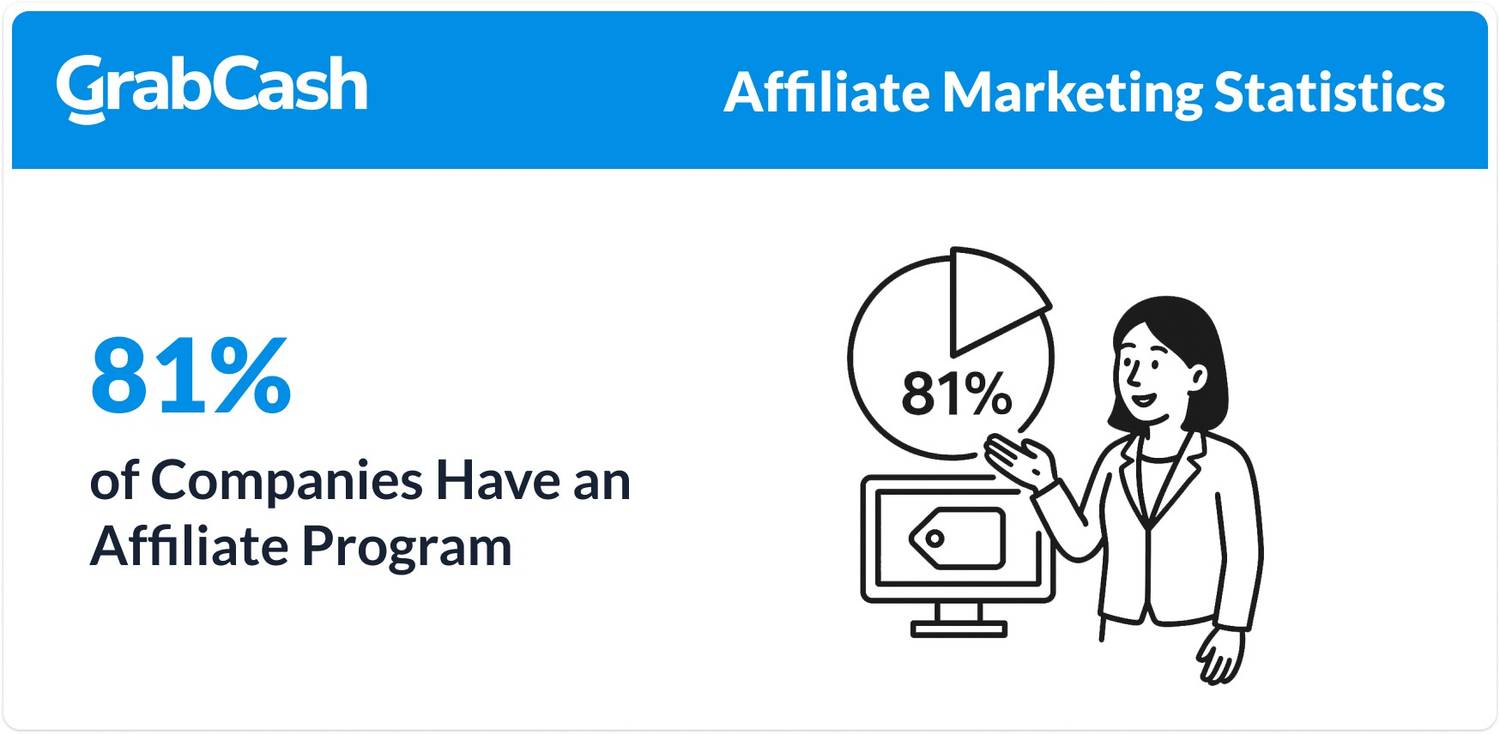
Nearly 80% of brands today run an affiliate marketing program, making it one of the most widely adopted strategies in digital marketing. As affiliate marketing works on a performance-based model where brands only pay when results are delivered, it keeps risk low and returns high.
For many companies, affiliates contribute anywhere from 5% to 25% of total online sales. With publishers, influencers, and content creators driving traffic and conversions, affiliate marketing has evolved from being a side tactic to a core part of modern growth strategies.
Average Earnings Of An Affiliate Marketer
| Income Range | Percentage |
| $20,000 or less | 19% |
| $21,000 – $40,000 | 10% |
| $41,000 – $80,000 | 10% |
| $81,000 – $120,000 | 14% |
| $121,000 – $200,000 | 13% |
| $201,000 – $400,000 | 7% |
| $401,000 – $800,000 | 8% |
| $801,000 – $1,000,000 | 2% |
| $1,001,000 – $2,000,000 | 11% |
| $2,000,000+ | 6% |
19% of affiliate marketers make $20,000 or less, making it the largest portion of the industry. Another 10% fall in the $21,000 to $40,000 range, and a similar 10% earn between $41,000 to $80,000. Mid-level earnings are also common, with 14% making $81,000 to $120,000 and 13% earning $121,000 to $200,000.
At the higher end, 7% of affiliate marketers bring in $201,000 to $400,000, while 8% earn between $401,000 to $800,000. Only 2% make $801,000 to $1,000,000, which is the smallest group. On the other hand, 11% earn $1 million to $2 million, and about 6% make over $2 million annually.
This breakdown shows that while a significant portion of affiliate marketers are still earning on the lower side, there is a clear path for higher income, with a considerable number crossing into six- and even seven-figure earnings.
Source: Authority Hacker.
Coupon and Deal Sites Are Among the Highest-Converting Affiliate Channels
Coupon and deal platforms consistently deliver some of the strongest conversion rates in affiliate marketing, largely because they catch shoppers at the very last step of the buying journey. Globally, the digital coupon market is valued at around $12.5 billion in 2026, and hunting for a promo code before checkout has become a routine part of online shopping.
Here is how deeply coupons now influence online shopping behavior.
| Shopper Behavior | Share of Online Shoppers |
| Search for coupons or discount codes before buying | 64% |
| Visit coupon websites to find working codes | 46% |
| More likely to try a new brand because of a coupon | 86% |
| Abandon a purchase if no coupon or discount is available | 15% |
According to the Admitad affiliate network, online purchases made using coupons grew by 20% globally in 2023, and Indian shoppers continue to increase both the frequency and value of coupon-led purchases.
The average order value of a coupon-applied purchase in India stands at around $36.6, with Delhi, Bengaluru, Hyderabad, Mumbai, and Chennai leading as the most active coupon-using cities. Beyond eCommerce, coupon-driven sales of online games and educational courses in India more than doubled in 2024, showing that discounts are now shaping purchases well beyond retail.
For brands, this makes coupon affiliates like GrabOn a high-intent channel. The shopper has already decided to buy, and the coupon simply closes the sale, which is why coupon and cashback partners often sit among the top revenue-driving publishers in affiliate programs.
Source: Admitad, Capital One Shopping.
The ROI of Affiliate Marketing
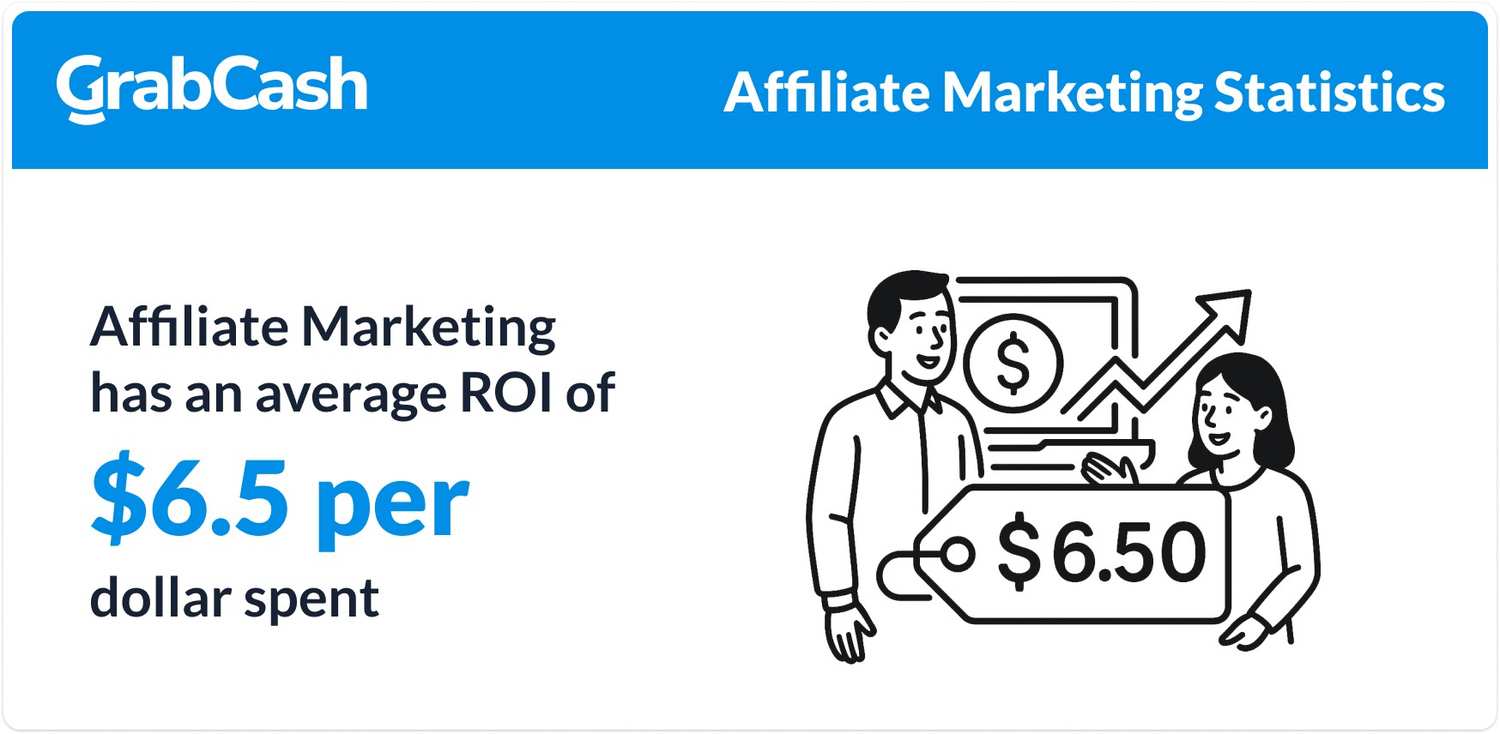
Affiliate marketing delivers one of the highest returns on investment, with businesses earning an average of $6.50 for every dollar spent. Its cost-effectiveness makes it a powerful marketing channel, especially in lucrative niches like finance, technology, and wellness.
Source: Publift.
Preferred Platforms By Affiliate Marketers
58.5% of all affiliate marketers use Amazon’s affiliate program “Amazon Associates”. The ClickBank affiliate program is the second most preferred by marketers, with a 24.6% share.
Here is a table showing the most popular affiliate programs among marketers.
| Platform | Share of marketers |
| Amazon Associates | 58.50% |
| ClickBank | 24.60% |
| ShareASale | 21.80% |
| CJ Affiliate | 20.50% |
| Impact | 15.70% |
| Awin | 11.70% |
| Rakuten Marketing | 7.00% |
| Linkshare | 5.50% |
| FlexOffers | 3.90% |
| eBay Partner Network | 3.30% |
| Avantlink | 3.10% |
| Skimlinks | 2.50% |
| Avangate | 1.70% |
Source: Authority Hacker.
SEO Remains The Top Traffic Getter For Affiliate Marketers
Most affiliate marketers rely heavily on organic traffic, with SEO being the top choice at 78.3%, and organic social media following at 35.5%. Paid options such as SEM and paid social ads don’t see the same adoption, with only 20.2% using them. Email stands as the third most common channel, used by 22.8% of affiliates, largely because it often delivers a stronger ROI compared to other methods.
High earners, however, take a different approach. Affiliates making six figures or more diversify their traffic sources by about 21.56% more than the average. Paid advertising and email marketing are two key areas where they expand, which not only reduces dependency on a single channel but also opens doors to higher revenue potential. This greater reliance on email could be one reason behind their stronger earnings.
Source: Authority Hacker.
Affiliate Marketing Income By Niche
| Niche | Average Monthly Income |
| Education & E-learning | $15,551 |
| Travel | $13,847 |
| Beauty & Skincare | $12,476 |
| Finance | $9,297 |
| Technology | $7,418 |
| Digital Marketing | $7,218 |
| Health & Fitness | $7,194 |
| E-commerce | $5,967 |
| Home & Garden | $5,095 |
| Sports & Outdoors | $4,849 |
| Entertainment | $4,416 |
| Food & Nutrition | $3,015 |
| Fashion | $2,049 |
| Personal Development | $1,566 |
| Parenting & Family | $1,145 |
| Arts & Crafts | $1,041 |
| Pets & Animals | $920 |
| Sustainability & Environment | $555 |
Affiliate income varies widely depending on the niche, with some categories standing out as clear leaders. For example, Education & E-learning tops the chart with an average monthly income of $15,551, followed by Travel at $13,847 and Beauty & Skincare at $12,476. Finance also remains a strong performer at $9,297, while Technology, Digital Marketing, and Health & Fitness each earn just over $7,000 per month on average.
These seven niches form the high-income tier, generating well above $7,000 per month. The rest fall into a mid-to-lower income range, spanning from around $500 to $6,000 monthly. Still, this “second tier” is far from insignificant—E-commerce, Home & Garden, Sports & Outdoors, and Entertainment all bring in solid figures between $4,000 and $6,000, which for many affiliates represents sustainable, job-level income.
Interestingly, 11 out of the 19 niches analyzed earn over $4,000 per month on average, underscoring the broad potential of affiliate marketing. While high-earning niches tend to attract more competition, they also show that strong returns are achievable across diverse industries. Even lower-income niches like Fashion, Parenting, Arts & Crafts, and Pets can still offer value, especially for affiliates targeting passionate or underserved audiences.
Source: Authority Hacker.
7 Out of 10 of Customers Prefer Recommendations Over Traditional Ads
About 69% of people say they are more likely to trust recommendations from friends, family, or influencers than from brands themselves. What consumers are really looking for is authenticity, whether it’s relatable stories, original content, or genuine expertise.
Interestingly, only 11% prefer celebrity influencers, showing that fame alone doesn’t drive trust. When asked what matters most when learning about a company or product, 39% of consumers chose authenticity as the key factor.
| Influencer Personality Type | Share of Consumers Who Find It Appealing |
| Relatable personalities | 61% |
| Expert personalities | 43% |
| Just-for-fun personalities | 32% |
| Aspirational personalities | 28% |
Source: Matternow.