

| Quick Summary: According to recent data, desktop traffic has surged while mobile traffic has declined. In June 2025, mobile traffic stood at 64.17% and desktop at 35.83%. By June 2026, mobile traffic dropped to 52.18%, while desktop traffic climbed to 47.81%. |
In 2016, mobile web browsing officially overtook desktop for the first time, and it shook the business world. Companies scrambled to make their sites mobile-friendly. For years, mobile held the crown, eventually dominating global website traffic. But if you think user behavior has flatlined, look at what has actually happened over the last year.
Recent data reveals an unexpected resurgence in desktop usage:
- June 2025: Mobile traffic stood at 64.17%, while desktop accounted for 35.83%.
- June 2026: Mobile traffic has dropped to 52.18%, whereas desktop traffic has surged to 47.81%. There was a 35.83% growth in desktop traffic, whereas mobile traffic declined by 18.68% in the last year.
As an affiliate marketer, this dramatic shift means your audience’s behavior is shifting. You need to know the exact differences between desktop and mobile visitors so you understand how they actually browse and buy today.
Let us break down the exact numbers you need to look at so you can build campaigns that actually convert.
Desktop vs. Mobile Traffic Statistics (Top Picks)
- As of Q2 2026, mobile devices accounted for 52.23% of global website traffic.
- In June 2026, mobile devices held a 52.18% share of internet usage worldwide, with desktops slightly ahead at 47.81%.
- Mobile traffic continues to lag behind desktop in conversion performance, converting shoppers at just up to 2.5%, compared to 4% on desktop.
- More than half (53%) of mobile visits are abandoned if a web page takes longer than three seconds to load.
- 80% of social media browsing happens on mobile devices.
- Indonesia had one of the highest mobile traffic market shares, with 78.54% of the traffic coming from mobiles and 20.56% coming from desktops.
- India’s mobile traffic market share was 67.53% (including tablets) in June, with desktop traffic share at 32.47%.
Global Internet and Mobile Penetration
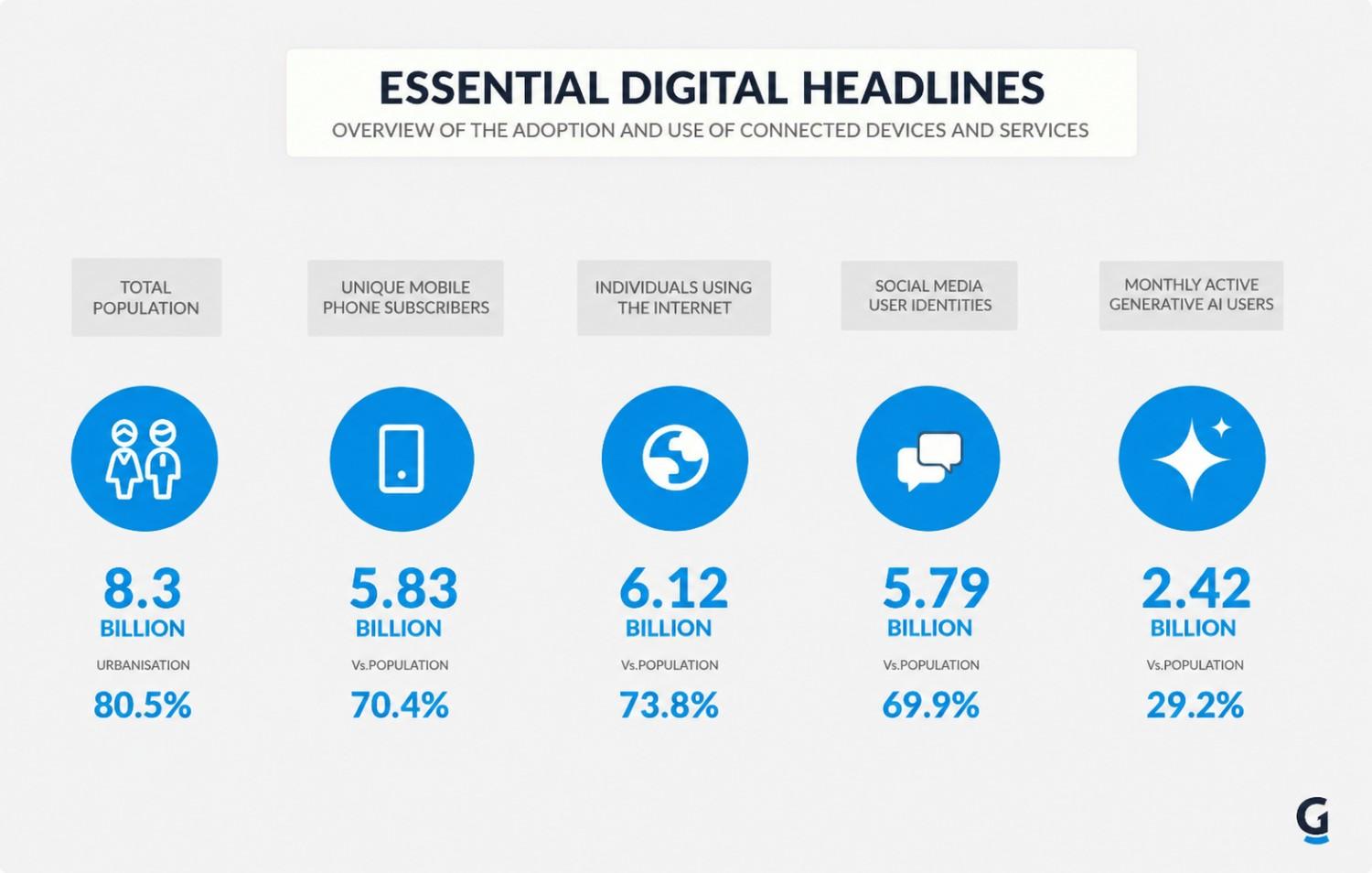
According to the data provided by the United Nations, the world population is 8.3 billion. Out of over 8.3 billion people, 5.83 billion people use a mobile phone, which is 70.4% of the world population. 6.12 billion people use the internet (as of April 2026), with 5.79 billion social media user identities, which is equal to 69.9% of all the people on Earth. And about 96.2% of internet users use a mobile phone to go online at some point.
Source: Data Reportal, Techjury
Mobile Device Website Traffic Statistics
Mobile device website traffic has grown steadily over the years. While it has seen occasional dips over a certain period, people are still very much using their mobiles to access websites. Since 2016, mobile devices have consistently captured a massive share of global website visits, but recent numbers tell a fascinating story of change: mobile traffic stood at 64.17% in June 2025 before dropping down to 52.18% in June 2026. Here’s a table describing the growth of mobile device website traffic from 2015 to 2026.
| Quarter | Mobile Device Traffic |
| Q1 2015 | 31.16% |
| Q2 2015 | 32.85% |
| Q3 2015 | 38.38% |
| Q4 2015 | 38.43% |
| Q1 2016 | 39.47% |
| Q2 2016 | 42.16 |
| Q3 2016 | 44.69% |
| Q4 2016 | 48.33% |
| Q1 2017 | 50.03% |
| Q2 2017 | 52.21% |
| Q3 2017 | 52.99% |
| Q4 2017 | 51.12% |
| Q1 2018 | 51.77% |
| Q2 2018 | 51.89% |
| Q3 2018 | 52.4% |
| Q4 2018 | 47.19% |
| Q1 2019 | 48.71% |
| Q2 2019 | 48.91% |
| Q3 2019 | 51.51% |
| Q4 2019 | 52.6% |
| Q1 2020 | 51.92% |
| Q2 2020 | 51.53% |
| Q3 2020 | 50.81% |
| Q4 2020 | 52.2% |
| Q1 2021 | 54.8% |
| Q2 2021 | 55.09% |
| Q3 2021 | 55.78% |
| Q4 2021 | 54.4% |
| Q1 2022 | 55.79% |
| Q2 2022 | 58.99% |
| Q3 2022 | 59.54% |
| Q4 2022 | 59.16% |
| Q1 2023 | 58.03% |
| Q2 2023 | 53.42% |
| Q3 2023 | 54.34% |
| Q4 2023 | 54.67% |
| Q1 2024 | 59.34% |
| Q2 2024 | 60.12% |
| Q3 2024 | 61.85% |
| Q4 2024 | 62.54% |
| Q1 2025 | 62.39% |
| Q2 2025 | 62.73% |
| Q3 2025 | 57.96% |
| Q4 2025 | 51.29% |
| Q1 2026 | 52.27% |
Source: Statista
Mobile vs. Desktop Market Share Worldwide
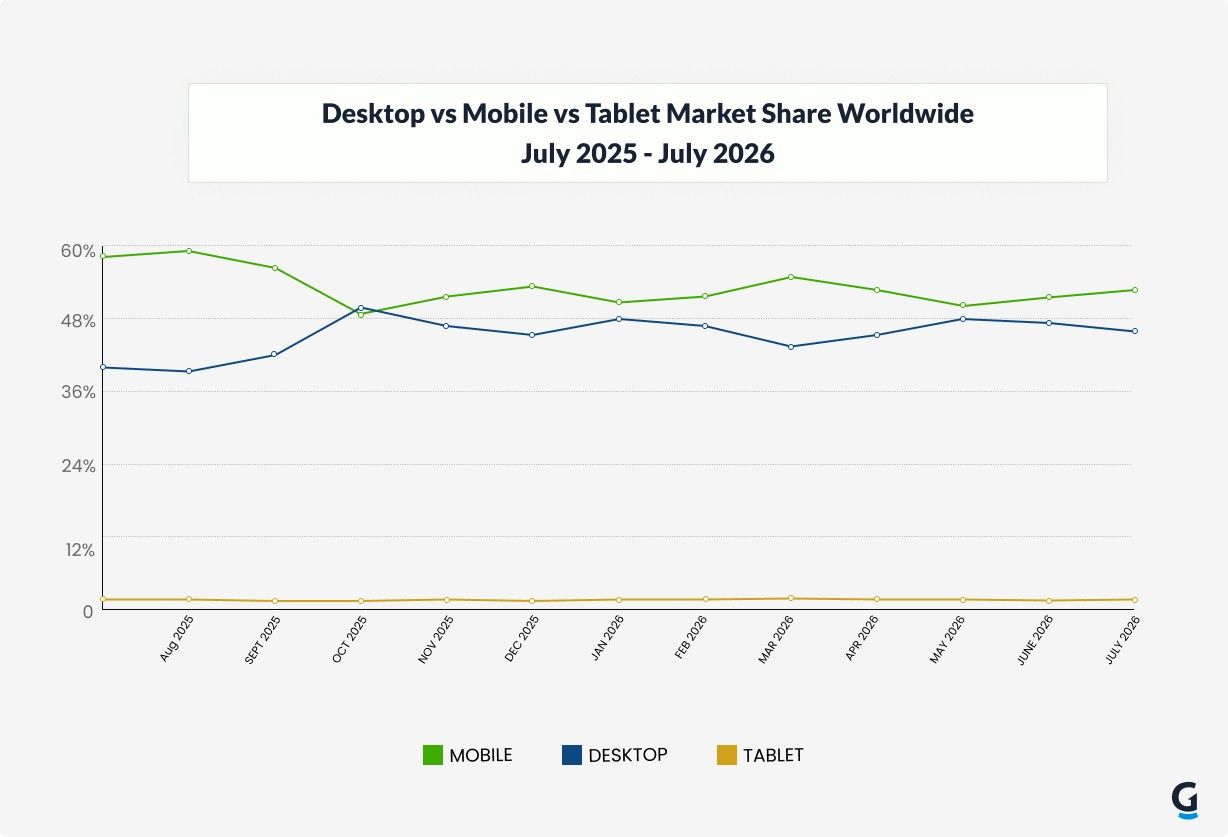
As per the latest data from StatCounter, the global market share of devices accessing the internet is nearly evenly split between desktops and mobile devices. Mobiles lead slightly with 51.51%, while desktops follow closely behind at 47.12%. Tablets constitute the smallest segment, accounting for just 1.36% of the total market share. The mobile market share has seen a steady decline in the past four months. It has dropped from 63.13% in June 2025 to 51.47% in June 2026. Whereas the desktop share has increased steadily from 35.24% in June to 47.17% in June 2026, representing a 33.85% relative growth over the year. Thus, focusing on just mobile optimization is not going to cut it; websites need to be optimized for viewing on all devices, like mobiles, desktops, and tablets.
Source: Statcounter
Mobile vs. Desktop Market Share India
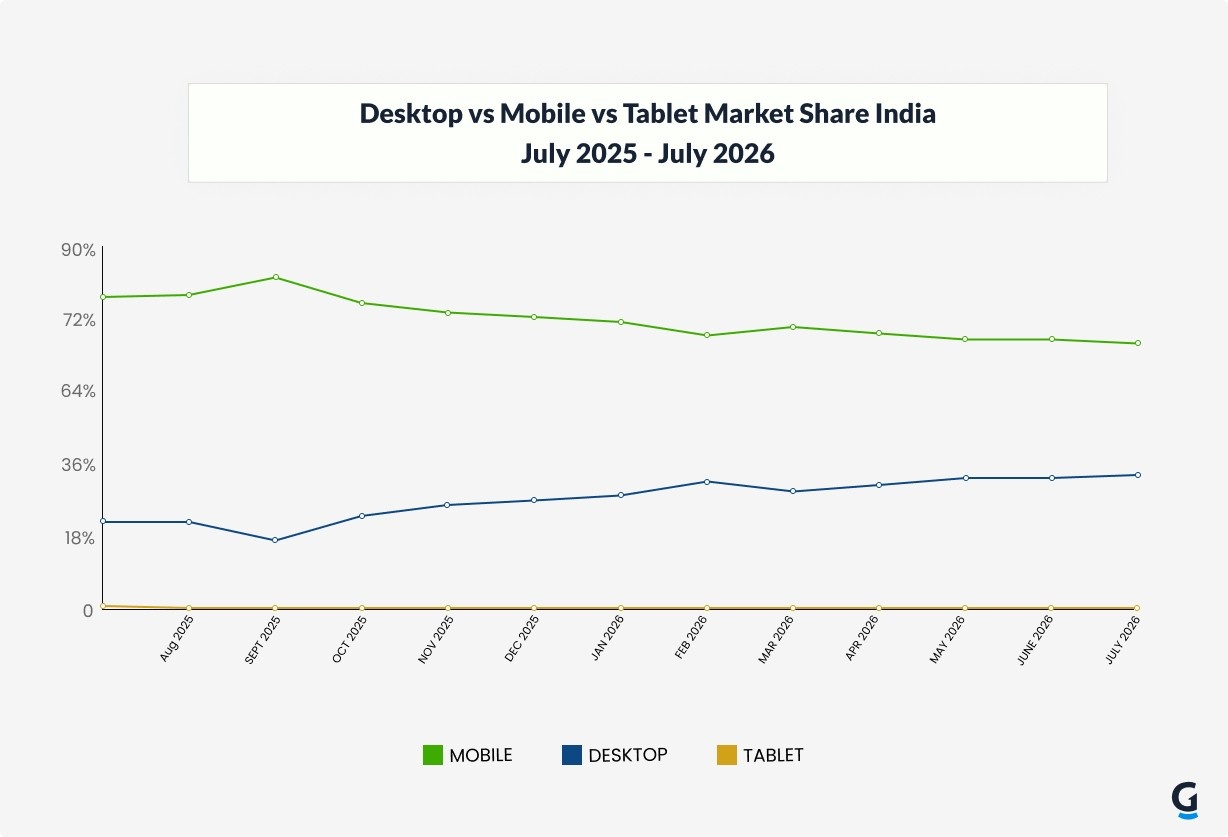
In India, mobile devices dominate internet access with a commanding market share of 67.15% as of June 2026. This indicates that almost three-quarters of web traffic originates from mobile phones, emphasizing the country’s strong preference for mobile connectivity. Desktop usage, by contrast, accounts for just 32.29%, reflecting a significantly smaller portion. Tablets make up a minimal fraction, with only 0.56% market share.
Source: Statcounter
Mobile vs. Desktop Click-Through Rates
There is a difference between how mobile users interact with affiliate links and how desktop users treat affiliate links. Mobile devices (1.5%) have higher click-through rates than desktops (0.9%). But in the next section, you can see that even though the CTR for mobile devices is higher than for desktops, desktops do have a higher conversion rate.
| Device Type | Average CTR |
| Mobile | 1.5% |
| Desktop | 0.9% |
Source: 50Folds
Mobile vs. Desktop Traffic Conversion Rates
While mobile shopping is still massive, the mobile conversion rates are lower than the desktop conversion rates. Here are the conversion rates on various devices:
| Device Types | Conversion Rates |
| Mobiles | 1.8% to 2.5% |
| Desktops | 3.5% to 4% |
Mobile conversion rates are lower because limited screen size makes navigation, form-filling, and checkout processes cumbersome. Moreover, mobile users usually browse during in-between moments with less intent on completing the purchase. Site speed also affects conversion because over 53% of mobile visitors abandon sites that take longer than 3 seconds to load.
Source: The Drum, Marketing Dive, Smart Insights
| NOTE: Smartphone conversion rates for retail average around 3%, but conversion is higher during seasonal sales in November and December. |
Mobile Web Traffic Share According to Device Type
Android controls the majority of mobile web traffic with a share of approximately 73.49%, while Apple’s iOS accounts for about 26.04%. Together, these two operating systems make up nearly 100% of the global mobile web traffic market in 2026. Affiliates can tailor their campaigns primarily for Android and iOS.
| Rank | Device Type | Share | Change over the Previous Year |
| 1 | Android | 73.49% | +3.01% |
| 2 | Apple | 26.04% | -2.76% |
| 3 | Samsung | 0.31% | -0.6% |
| 4 | KAI | 0.03% | -0.11% |
| 5 | Other | 0.13% | -0.8% |
Source: Exploding Topics
Optimal Mobile Traffic Browsing Characteristics
According to a study by Scispace, it is mentioned that there are certain elements that impact visitor behavior and mobile traffic. There are ways you can improve your website and increase conversion rates.
| Aspect | Description | Implication for Affiliates |
| Dwell Time Range | Typically between 2 and 70 seconds | Content and CTAs should fit within typical engagement windows |
| Webpage Size | Mobile pages vary significantly, typically between 60 KB and 1500 KB in size. | Optimize page size to reduce load times and user abandonment. |
| Page Load Time | Expected to be under 15 seconds; over 10 seconds is perceived as unresponsive, leading to session abandonment. | Prioritize speed optimizations for mobile pages to reduce bounce rates. |
| Session Behavior | Users visit multiple pages in a session with varying dwell times; session size is better measured by time than by bytes. | Create smooth navigation and seamless transitions between pages. |
Source: Scispace
Mobile vs Desktop Traffic Market Share by Countries
Countries like Indonesia, Japan, and India show very high mobile usage, above 70%, reflecting mobile-first markets where smartphones are the primary internet access devices. Developed countries such as Singapore, the United States, Canada, Australia, and parts of Europe, like Germany and France, still show significant desktop presence, with desktop usage close to or exceeding 40%. Affiliate targeting countries with high mobile usage should prioritize mobile-optimized content and campaigns. While in countries with balanced or desktop-leaning traffic, a hybrid approach addressing both device types would be optimal.
| Country | Mobile | Desktop | Tablet |
| Indonesia | 78.54% | 20.56% | 0.89% |
| Japan | 74.73% | 23.56% | 1.71% |
| India | 72.6% | 26.85% | 0.55% |
| Philippines | 70.75% | 27.86% | 1.39% |
| Italy | 69.57% | 29.13% | 1.31% |
| United Kingdom | 67.36% | 30.31% | 2.34% |
| Brazil | 65% | 34.23% | 0.77% |
| Germany | 64.46% | 33.72% | 1.82% |
| France | 62.79%% | 35.49% | 1.73% |
| Argentina | 61.35% | 38% | 0.65% |
| Australia | 59.28% | 38.72% | 2.01% |
| United Arab Emirates | 59.17% | 39.75% | 1.08% |
| Canada | 58.29% | 39.09% | 2.61% |
| United States | 54.97% | 43.17% | 1.86% |
| Singapore | 13.64% | 85.99% | 0.36% |
Source: Similarweb
Desktop Website Traffic Statistics
The Desktop website traffic has increased from 35.83% in June 2025 to 47.82% in June 2026. The numbers show that there was a huge spike in desktop traffic in the past year.
| Quarter | Desktop Website Traffic |
| Q1 2015 | 68.84% |
| Q2 2015 | 67.15% |
| Q3 2015 | 61.62% |
| Q4 2015 | 61.57% |
| Q1 2016 | 60.53% |
| Q2 2016 | 57.84% |
| Q3 2016 | 55.31% |
| Q4 2016 | 51.67% |
| Q1 2017 | 49.97% |
| Q2 2017 | 47.79% |
| Q3 2017 | 47.01% |
| Q4 2017 | 48.88% |
| Q1 2018 | 48.23% |
| Q2 2018 | 48.11% |
| Q3 2018 | 47.6% |
| Q4 2018 | 52.81% |
| Q1 2019 | 51.29% |
| Q2 2019 | 51.09% |
| Q3 2019 | 48.49% |
| Q4 2019 | 47.4% |
| Q1 2020 | 48.08% |
| Q2 2020 | 48.47% |
| Q3 2020 | 49.19% |
| Q4 2020 | 47.8% |
| Q1 2021 | 45.2% |
| Q2 2021 | 44.91% |
| Q3 2021 | 44.22% |
| Q4 2021 | 45.6% |
| Q1 2022 | 44.21% |
| Q2 2022 | 41.01% |
| Q3 2022 | 40.46% |
| Q4 2022 | 40.84% |
| Q1 2023 | 41.97% |
| Q2 2023 | 46.58% |
| Q3 2023 | 45.66% |
| Q4 2023 | 45.33% |
| Q1 2024 | 40.66% |
| Q2 2024 | 39.88% |
| Q3 2024 | 38.15% |
| Q4 2024 | 37.46% |
| Q1 2025 | 37.61% |
| Q2 2025 | 37.27% |
| Q3 2025 | 42.7% |
| Q4 2025 | 45.86% |
| Q1 2026 | 44.06% |
| Q2 2026 | 47.82% |
Source: Statista, StatCounter
Desktop vs. Mobile Usage Throughout the Day
In the table below, we explain how mobile and desktop devices are used differently throughout the day and for different purposes.
| Usage Aspect | Mobile Traffic | Desktop Traffic | Implications for Affiliates |
| Daily Usage Pattern | Consistent usage throughout the day and night due to portability and on-the-go access | Concentrated during business hours (7 AM to 7 PM) | Run mobile campaigns 24/7; focus desktop campaigns on business hours |
| Peak Purchase Time | Spread over the day with flexible browsing | Peaks around typical business/work hours (e.g., 2 PM in Switzerland) | Optimize time-based targeting by device |
| User Demographics & Trust | Younger, dynamic users; less trust, more casual browsing | Older demographics; higher trust in desktop for serious transactions | Segment campaigns by age and trust level |
| Engagement | Shorter sessions, higher bounce rates, but broader reach | Longer sessions, more pages per visit, lower bounce rate | Use quick-impact ads for mobile and detailed content for desktop |
| Conversion Rate | Lower rates due to usability challenges and distractions | Higher rates, preferred for complex tasks and checkout | Mobile optimization critical; desktop suitable for big-ticket or detailed conversions |
According to the patterns above, affiliates should run mobile campaigns around the clock to increase reach, while focusing desktop campaigns on business hours for higher conversion potential. For casual and entertainment offers, you can use mobile marketing, but for professional verticals like finance, where trust matters, desktop marketing is the way.
Source: Propeller Ads
High-Performing Verticals and Geographies for Mobile and Desktop Campaigns
Mobile campaigns perform best in regions like North America, Europe, LATAM, Asia, and Africa. iGaming, Extensions, eCommerce, Finance, and Games are some mobile verticals with strong performance. Desktop traffic is suitable for business-related and forms-heavy campaigns. Popular desktop verticals include iGaming, iOS, and Android apps.
| Device Type | Vertical | Top Geographies |
| Mobile | Extensions | North America: US, CA; Europe: GB, DE, IT, ES, FR; Australia: AU |
| Mobile | iGaming | US, BR, CL, PE, KE, NG, ZA, EG, IN, PH, GB, IT, NL, CA, DE, FR, NZ, ID, SE, PH, MX |
| Mobile | eCommerce | US, ID, PL, DE, PH, TH, MY, GB, KR, IT, FR |
| Mobile | Finance | Europe: DE, FR, ES, GB, CZ; Africa: NG, ZA; Asia: IN, JP, TR, TH, ID, PH, MY, KR, PK; LATAM: BR, MX |
| Mobile | Games | PL, DE, US, TR, FR, HU, VN, CZ |
| Desktop | iGaming | BR, PH, VN, ID, ZA, IN, TH, MY, ZM, AO, CO, MZ, NG, CI, PE, CM, KE, EC, CD, MW, ML, TZ, CL, EG, GH |
| Desktop | iOS Apps (VPNs) | BR, MX, SA, KR, PH, EG, TR, JP |
| Desktop | Android apps | PH, IN, ID, BR, TH, ZA, NG, MX |
| Desktop | Finance | CZ, IN, GR, HU, EG, NG, SA, KE |
| Desktop | e-Commerce | TH, PH, ID, MY, VN, SG, JP |
| Desktop | Mobile Content | ID, NG, CL, MY, PH, CM, SN, KE, DZ, GH, CD |
Source: Propeller Ads
Bonus: Mobile Vs Desktop Traffic Statistics
- As of 2026, an average adult internet user now spends 33 hours and 13 minutes each week consuming online media.
- 56.2% of internet users aged 16+ buy something online every week.
- Younger groups spend more time on mobile devices, while the older groups lean more toward desktops and linear TV.
- Among internet users aged 16 to 34, social media ads are the leading channel for brand discovery, yet less than one-third of respondents in this group actually select social ads as their primary source for finding new brands or products.
- For audiences aged 35 and older, search engines become the top source for finding brands and products, with TV ads ranking second, while social media ads drop in importance.
- 7 out of 10 customers prefer recommendations over traditional Ads; they say they are more likely to trust recommendations from family and friends over brands themselves.
Source: Datareportal Global Digital Overview, Datareportal(2025), Affiliate Marketing Statistics GrabCash
Wrapping up
We hope these numbers helped you understand the differences between desktop and mobile traffic, and affiliates need to strategize accordingly. While Mobile traffic dominates, desktop traffic converts more. To create the smartest campaigns, you need to embrace both worlds. You need to tailor messages and creatives that fit how people use their devices. Keep a close eye on the evolving trends and create marketing strategies that convert.