
India’s creator and content economy has moved well past the experimental stage. What started as a side hustle for a handful of bloggers and Instagram accounts is now a multi-crore industry with its own rate cards, compliance rules, and career paths. Two models sit at the center of it: affiliate marketing and influencer marketing.
Both let you earn from an audience without owning a product. Both have grown sharply in recent years. But they work on different mechanics, pay out on different timelines, and suit different kinds of creators. This blog breaks down the current data on both models, where they overlap, and how to decide which one fits your content and your goals.
Quick Summary (TL;DR)
- Affiliate marketing pays you a commission when someone buys through your tracked link. It is performance-based, scalable, and keeps earning from old content long after you publish it.
- Influencer marketing pays you (often a flat fee) to create content for a brand, regardless of whether it converts into sales. It rewards reach, trust, and engagement rather than clicks.
- India’s affiliate marketing revenue is estimated at around USD 635 million in 2026, growing at roughly 8.9% CAGR toward USD 1.2 billion by 2033.
- India’s influencer marketing industry is projected to reach INR 3,375 crore in 2026.
- Neither model guarantees quick income. Most beginners in both categories earn little to nothing in the first few months while they build an audience and a track record.
What is Affiliate Marketing?
Affiliate marketing is a performance-based model where you promote a brand’s products or services using a tracked referral link and earn a commission whenever someone clicks that link and completes a purchase, sign-up, or other defined action. You don’t need to hold inventory, handle shipping, or run customer support. Your job is to bring qualified traffic and match it with the right offer.
It works well for bloggers, YouTubers with review content, deal-and-coupon sites, and anyone who already publishes content with buying intent behind it. If you’re new to the concept, our guide on easy ways to earn money online in India covers where affiliate marketing fits among other online income options.
What is Influencer Marketing?
Influencer marketing is a collaboration model where brands pay creators, usually a flat fee per post or campaign, to produce content that reaches the creator’s audience. Instead of tracking every sale, brands are paying for attention, trust, and brand recall. Payment isn’t always tied to whether a viewer buys anything.
This model rewards creators who’ve built a loyal, engaged following, whether that’s 5,000 people on a niche cooking page or 500,000 on a lifestyle channel. Increasingly, brands also pay influencers a hybrid rate: part flat fee, part commission on sales the content drives, which is where the line between the two models starts to blur.
Affiliate or Influencer marketing: Which pays better?
There’s no single answer. Top performers in both models can reach six-figure monthly incomes in INR, but they get there differently.
Affiliate income tends to compound. A well-ranked blog post or an evergreen YouTube review can keep generating commissions for months or years after publishing, with almost no extra effort. Influencer income is closer to project-based freelance work: it pays well per campaign, but the moment you stop posting sponsored content, the income stops too, unless you’re also running affiliate links on the side.
If you want scalable income and don’t mind the slower ramp-up, affiliate marketing pays well in the long run. If you already have an engaged audience and enjoy creating content, influencer marketing usually pays faster per piece of content.
Affiliate Marketing Statistics and Insights
Affiliate marketing is growing popular as a performance-driven income model in India’s digital landscape. With measurable ROI and growing brand participation, it’s redefining how creators and businesses monetize online. The stats below highlight its global growth, market trends, and future potential.
Global Affiliate Marketing Overview
- The global affiliate marketing industry was valued at over $22.6 billion in 2025, reflecting its massive presence across international markets.
- The affiliate marketing industry is growing steadily at a CAGR of 5.9%. This shows that brands are now relying more on performance-based marketing.
- Around 81% of global brands now incorporate affiliate marketing into their promotional strategies.
- On average, companies generate an ROI of $15 for every $1 invested, proving that affiliate marketing remains one of the most profitable digital channels.
Channels and Platforms for Affiliate Marketing
- Over 28% of brands prefer using blogs as their main affiliate marketing channel, as they allow for detailed product reviews and SEO-driven sales.
- With growing smartphone adoption, more than 50% of affiliate traffic now comes from mobile devices, making mobile optimization a necessity for marketers.
- Over three-fourths of affiliate marketers use Facebook to share affiliate links. Specifically, around 75.8% turn to Facebook as their primary promotion channel. This makes Facebook the most popular social platform for affiliates, ahead of Instagram (61.4%) and YouTube (36.9%).
Affiliate Marketing Statistics Across Regions
Asia Pacific affiliate market share by country
- The Asia-Pacific affiliate marketing platform industry has expanded from $4658.3 million in 2021 to $6352.83 million in 2025, marking an impressive 36.38% growth in four years.
- By 2033, the Asia-Pacific affiliate marketing industry is expected to touch $11,996.5 million, supported by an 8.27% CAGR.
- Within the region, China dominates with $2187.44 million, followed by Japan at $1226.69 million and India at $635 million.
Other contributors include Southeast Asia ($381.33 million) and Taiwan ($203.29 million), showing how diversified the regional growth is.
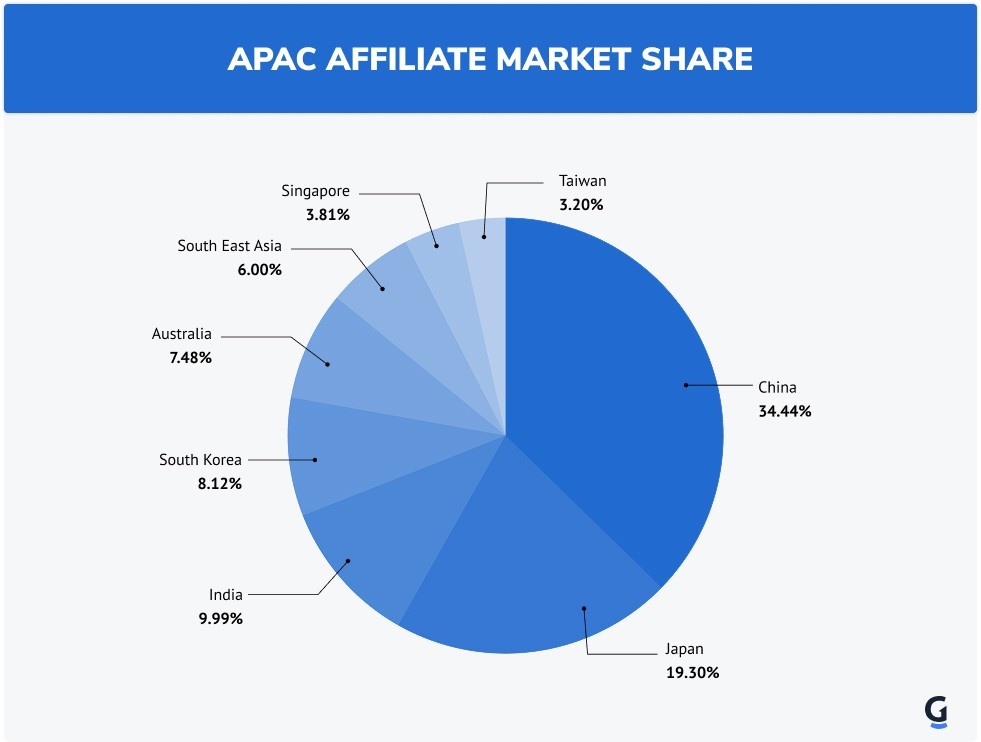
| Country / sub‑region | 2025 revenue (USD million) | Share of APAC affiliate market (%) |
| China | 2187.44 | 34.44% |
| Japan | 1226.69 | 19.30% |
| India | 635.00 | 9.99% |
| South Korea | 515.60 | 8.12% |
| Australia | 474.80 | 7.48% |
| South East Asia | 381.33 | 6.00% |
| Singapore | 241.99 | 3.81% |
| Taiwan | 203.29 | 3.20% |
| Total Asia Pacific | 6352.83 | 100.00% |
India and the USA Comparison
- India’s affiliate marketing platform revenue was $452.37 million in 2021 and reached $635 million in 2025, with an estimated $1264 million by 2033, growing at a strong CAGR of 8.996%.
- The United States, while larger in absolute size, is growing at a relatively slower pace: from $3,793.45 million in 2021 to $5,722.44 million in 2025, and further to $13,018.9 million by 2033, with a CAGR of 10.82%.
India & USA Affiliate Market Revenue Comparison
| Country | 2021 Revenue | 2025 Revenue | 2033 Projection | CAGR |
| India | $452.37 Million | $635 Million | $1264 Million | 8.996% |
| USA | $3,793.45 Million | $5,722.44 Million | $13,018.9 Million | 10.82% |
This data highlights that India is among the fastest-growing affiliate markets, driven by e-commerce expansion, influencer integration, and digital transformation. Read more global insights on affiliate marketing trends and statistics shaping the industry.
What Drives Affiliate Marketing’s Growth?
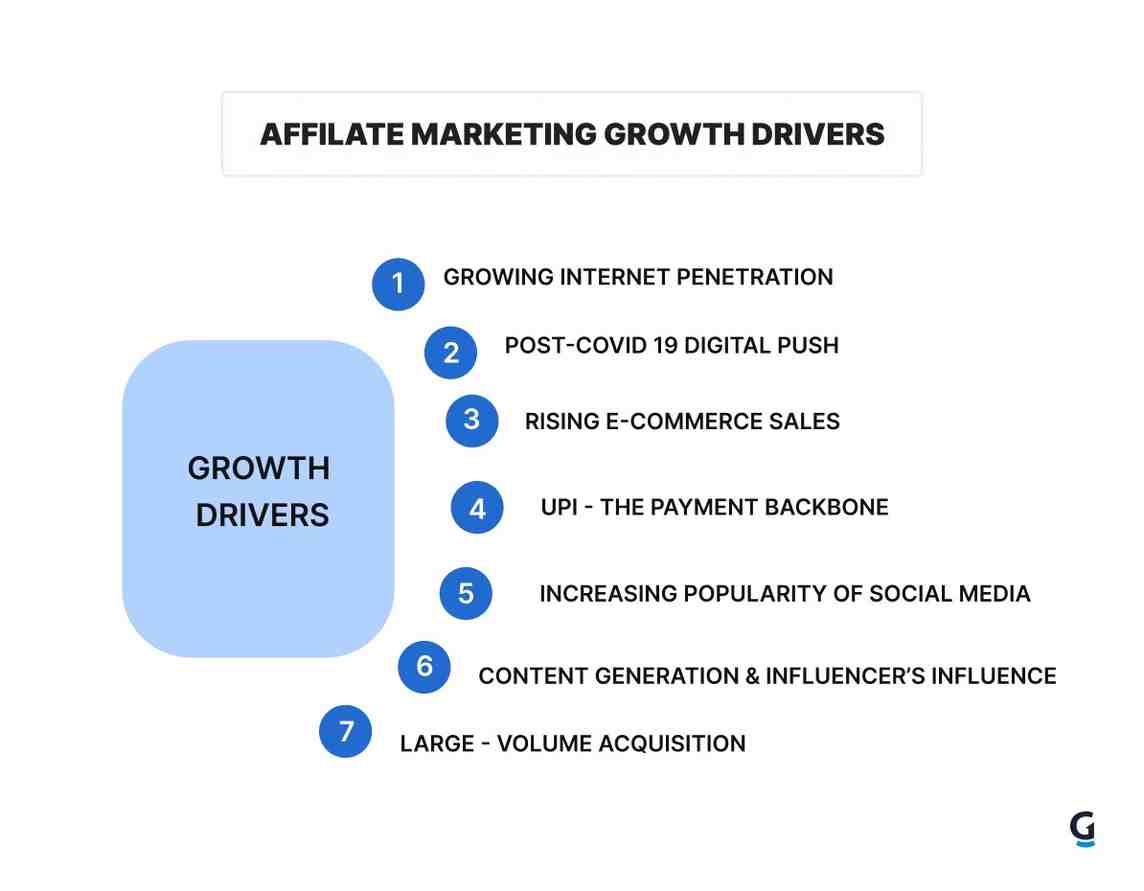
- Rising smartphone penetration and mobile internet adoption are boosting affiliate reach. E-commerce expansion and Digital India initiatives strengthen online sales infrastructure.
The growth is further driven by India’s expanding internet reach, UPI-enabled digital payments, rising social media influence, and the post-COVID digital push. This has boosted content creation and large-scale online customer acquisition.
- Over 84% of online content publishers are involved in affiliate marketing activities.
- The influencer-driven segment of affiliate marketing in India is expected to reach $75 million by 2025.
- India’s digital ad spending is projected to hit $21 billion by 2028, further supporting affiliate growth.
Affiliate Marketing Challenges & Consumer Insights
- Only 52% of Indian consumers trust online advertising, which is lower than the global average of 61%, indicating a need for more authentic brand communication.
- The average affiliate conversion rate in India is around 2%, which lags behind the global average of 4%, highlighting the importance of credibility and audience targeting.
These challenges show that Indian affiliates must focus on building trust, improving conversion funnels, and offering value-driven content.
Earning Potential in Affiliate Marketing
- In the US, the average annual income for affiliate marketers sits around USD 82,000, though this varies enormously by experience and niche, from around USD 15,500 at the low end to USD 125,000+ for the top 10% of earners. Experienced affiliates with the right strategy and traffic can earn many multiples of what beginners make; the gap between a first-year affiliate and a five-year veteran is often 50x to 100x, not a modest step up.
- India’s numbers are less dramatic but growing quickly, with realistic monthly earnings ranging from a few thousand rupees for beginners promoting a single product to several lakhs a month for affiliates who’ve built traffic across multiple niches. For real payout examples by traffic size and niche, see our affiliate marketing income guide for India.
(Sources: Affiliate Statistics, Grand View Research, Cognitive Market Research, Internet and Mobile Association of India, ZipRecruiter)
Influencer Marketing Data and Insights
Influencer marketing is no longer just about followers, it’s about trust, creativity, and genuine connection. The insights below reveal how this dynamic industry is growing, evolving, and shaping the future of online marketing.
Global Influencer Market Overview
- The global influencer marketing industry was valued at $10 billion in 2020 and has surged to $45.2 billion in 2026.
This rapid rise underscores the global shift toward creator-led marketing strategies that prioritize engagement and authenticity.
Indian Market Growth in Influencer Marketing
- India’s influencer marketing industry is projected to reach INR 3375 crore by 2026, driven by higher brand investments and audience engagement.
- Nearly 75% of brands in India have now integrated influencer marketing into their overall marketing strategies, showing widespread adoption across sectors.
Brand Strategies and Agency Roles
- A recent survey by EY reveals that 3 out of every 4 brands plan to include influencer marketing as a permanent part of their brand strategy.
- Around 77% of brands trust their marketing agencies to effectively plan and manage influencer campaigns, highlighting the professionalization of this segment.
- When selecting influencers, brands now prioritize audience engagement rate and content quality over the follower count.
Influencer Earnings and Growth
- Over 77% of influencers in India have reported income growth over the last two years, reflecting strong monetization opportunities.
- A large majority, around 86% of influencers, expect their income to increase by more than 10% over the next two years.
Despite this, only 12% of influencers currently earn between ₹1 lakh and ₹10 lakh annually, revealing income concentration among mid and top-tier creators.
- About 47% of brands prefer working with micro influencers (typically 10K to 100K followers) and nano influencers (1K to 10K followers) because they deliver higher engagement at a lower cost per reach.
Which Platforms do Influencers Prefer?
- Instagram leads influencer engagement with 169% performance, followed closely by YouTube at 163%.
Instagram dominates lifestyle, beauty, and fashion campaigns, while YouTube continues to lead in educational, tech, and long-form content. Other niche platforms are being used strategically for regional or interest-specific influencer collaborations.
Platform Preferences in Influencer Marketing
| Platform | Engagement / Performance Index (%) | Insight |
| 169% | The most dominant influencer platform with the highest engagement and audience reach. | |
| YouTube | 163% | Strong video-based platform driving long-form influencer collaborations and reviews. |
| 133% | Continues to deliver solid performance with broad audience demographics. | |
| Snapchat | 125% | Gains popularity among younger audiences through interactive and visual content. |
| ShareChat | 97% | Performs close to the average, driven by regional language content. |
| MOJ | 78% | Growing traction in short-form content, especially in Tier 2 and Tier 3 cities. |
| Chingari | 59% | Moderate engagement levels, gaining presence in vernacular content markets. |
Strategic Insights for Influencer Marketing
- Influencer marketing in India has evolved into a structured, agency-led ecosystem, where data and performance metrics guide decision-making.
- Brands are now placing importance on authentic engagement and long-term collaborations instead of one-off sponsored posts.
- Many creators are also merging affiliate links with influencer campaigns, forming hybrid monetization models that boost their earning potential.
All You Need to Know About Influencer Marketing
Influencer marketing is a strategy where brands collaborate with social media creators or online personalities (known as influencers) to promote their products or services. Instead of relying on traditional ads, brands use influencers’ authenticity and audience trust to drive engagement, awareness, and conversions. In India, this form of marketing has evolved rapidly, blending creativity, content, and commerce.
Pros and Cons of Influencer Marketing
| Pros | Cons |
| High engagement and brand visibility | High cost for top influencers |
| Audiences often trust influencers more than direct brand ads | Not every campaign guarantees measurable conversions. |
| Influencers personalize brand messaging through creative content formats. | Some influencers may have fake followers, affecting campaign authenticity. |
| Brands can target specific demographics and interests effectively. | Brands have less say over tone and content once it’s in the influencer’s hands. |
| Influencer promotions can lead to more organic mentions and shares. | Influencer-driven visibility often peaks quickly unless part of a long-term partnership. |
Tools You Need for Influencer Marketing
To make influencer campaigns more effective, creators and brands need the right tools to plan, track, and measure performance. From discovering authentic influencers to analyzing engagement rates and ROI, these tools help streamline every stage of an influencer marketing strategy-
- BuzzSumo: Helps identify trending topics and top-performing influencers in your niche.
- HypeAuditor: Evaluates influencer credibility and engagement quality, filtering fake followers.
- Upfluence, Aspire: Full-stack influencer marketing platforms that manage campaigns and payments.
- Klear: Offers audience insights, influencer discovery, and performance analytics.
- Canva, CapCut: Essential for creating visually engaging posts and short-form videos.
- Google Analytics, Bitly: Tracks influencer-driven referral traffic and conversion rates.
- Social Blade: Monitors influencer growth, reach, and platform statistics over time.
All You Need to Know About Affiliate Marketing
Affiliate marketing is a performance-based digital marketing strategy where an affiliate (individual or business) promotes another company’s products or services and earns a commission for each sale, lead, or action generated through their referral link. In simpler terms, it’s earning money online by promoting brands through blogs, websites, or social media. It’s one of the most sustainable income streams for creators and publishers worldwide.
Pros and Cons of Affiliate Marketing
| Pros | Cons |
| Anyone can start with minimal investment by joining affiliate programs for influencers or brands. | Popular niches like fashion, tech, and beauty are already saturated with affiliates. |
| Once set up, affiliate content can earn money 24/7 with minimal ongoing effort. | It takes time to build traffic and trust before seeing consistent sales. |
| Diverse monetization options like physical goods, software, or digital courses. | Sudden policy or commission rate changes on affiliate platforms can affect earnings. |
| More traffic and better content lead to exponential growth in earnings. | Conversions may not always get credited accurately. |
| Affiliates can collaborate with reputable affiliate brands for credibility and long-term growth. | Affiliates must follow disclosure and privacy guidelines strictly. |
Affiliate Programs for Influencers
For creators who want to earn beyond sponsored posts, affiliate programs for influencers offer the perfect opportunity to generate commission-based income by promoting trusted brands.
By joining the right influencer affiliate programs, content creators can combine creativity with measurable performance and long-term income potential. Some of the most popular and high-paying affiliate platforms include:
- GrabCash: A fast-growing affiliate and influencer marketing platform that helps creators partner with top e-commerce and lifestyle brands. GrabCash empowers influencers to earn commissions for every successful referral while offering real-time tracking, performance insights, and exclusive brand deals.
- Amazon Influencer Program: Ideal for YouTubers and Instagram reviewers who want to recommend products through personalized storefronts and affiliate links.
- Impact, Rakuten Advertising: Global affiliate networks that connect influencers with hundreds of international brands across niches like fashion, tech, and finance.
- vCommission, Admitad India: Leading Indian affiliate platforms offering access to domestic and global eCommerce brands.
- Shopify and Bluehost Affiliate Programs: Perfect for business, startup, and tech creators who target entrepreneurial audiences.
- Nykaa, Sephora, and other beauty affiliate programs: Great for lifestyle and beauty influencers focusing on product recommendations and tutorials.With the data provided above, we get clear insights into how both affiliate and influencer marketing have evolved as key drivers of online income in India.
Concluding: Affiliate Marketing Vs Influencer Marketing
The following table summarizes how affiliate marketing focuses on performance-based sales through scalable and low-risk campaigns, while influencer marketing emphasizes trust, reach, and brand engagement through more personalized and creative collaborations. Both models play distinct yet complementary roles in modern marketing.
Affiliate Marketing Vs Influencer Marketing
| Category | Affiliate Marketing | Influencer Marketing |
| Primary Goal | To drive measurable sales, leads, or website traffic through performance tracking. | To build brand awareness, credibility, and engagement among a targeted audience. |
| Revenue Model | Income is commission-based – affiliates earn only when a conversion occurs (pay-per-sale, pay-per-lead, etc.). | Income is fee-based or hybrid, where influencers are paid per post, per campaign, or through a performance bonus. |
| Measurement of Success | Measured by conversion metrics such as clicks, sales, ROI, and customer lifetime value. | Measured by engagement metrics such as likes, comments, reach, and impressions. |
| Content Ownership | Affiliates usually create evergreen content (like blogs, videos, and product reviews) that continues to generate passive income over time. | Influencers produce time-sensitive content (like reels, stories, or posts) that peaks quickly but drives immediate visibility. |
| Longevity of Impact | Provides long-term and compounding income, as content keeps earning even months after publication. | Offers short-term impact, best suited for product launches, campaigns, and brand awareness drives. |
| Trust Factor | Relies on informational trust – audiences believe in data, reviews, and the credibility of the affiliate source. | Relies on personal trust – followers value the influencer’s personality, authenticity, and recommendations. |
| Cost to Brand | Typically low-risk and cost-effective, since brands pay only when conversions happen. | Generally, higher cost, as payments are made upfront regardless of direct sales results. |
| Scalability | Easily scalable, since affiliates can promote multiple products or brands simultaneously. | Limited scalability, as influencer content and audience are personalized and time-bound. |
| Platforms Used | Commonly run through blogs, YouTube, comparison sites, email newsletters, and affiliate platforms. | Primarily conducted on social platforms like Instagram and YouTube, managed through influencer marketplaces. |
| Brand-Influencer Relationship | Affiliates work as independent promoters with minimal brand involvement. | Influencers act as brand partners or ambassadors, often developing close, creative collaborations. |
| Return on Investment (ROI) | Offers clear, trackable ROI since every sale is measurable. | ROI is qualitative, reflecting visibility, engagement, and sentiment rather than direct conversions. |
| Skillset Required | Requires strong skills in SEO, content writing, analytics, and conversion optimization. | Requires creativity, storytelling ability, on-camera confidence, and community management. |
| Best For | Bloggers, content creators, review-based websites, and affiliate influencers who focus on measurable performance. | Social media creators, lifestyle influencers, and brand advocates who focus on audience engagement and awareness. |
| Overall Advantage | Provides sustainable, long-term income with measurable performance results. | Delivers high visibility and brand credibility through authentic social engagement. |
Frequently Asked Questions
How much can I realistically earn from affiliate marketing in India per month?
Earnings range widely based on niche, traffic, and experience, from a few thousand rupees a month for beginners with limited traffic to several lakhs a month for established affiliates with multiple ranking posts and diversified programs. Most people earn very little in the first three to six months while building an audience; consistent income usually shows up after that initial ramp-up period.
Do influencers in India need to register for GST?
Generally, yes, once your annual income from brand deals or affiliate commissions crosses INR 20 lakh. Income tax applies at lower thresholds regardless of GST status. This is general information, not personalized tax advice, so check with a chartered accountant once your income becomes substantial.
What is the ASCI disclosure rule for influencers in 2026?
ASCI requires disclosures to be prominent, upfront, and unambiguous, meaning “#Ad” is clearly stated rather than buried in a hashtag cluster. Video content needs a verbal disclosure early in the clip in addition to an on-screen label, and finance or health influencers must also disclose relevant qualifications when giving product-specific advice.
Can I do affiliate marketing and influencer marketing at the same time?
Yes, and a growing number of Indian creators do exactly this. A common approach is accepting brand deals for upfront income while adding affiliate links to bios, captions, and video descriptions so older content keeps earning commissions after a campaign ends.
What is the minimum number of followers needed to become an influencer in India?
There’s no official minimum. Nano influencers with as few as 1,000 to 10,000 highly engaged followers are actively sought after by brands, particularly D2C companies, because they often deliver stronger engagement rates than accounts with hundreds of thousands of passive followers.
Is affiliate marketing free to start?
Yes, in most cases. Signing up for affiliate programs is free; your only real investment is the time it takes to build content, and optionally, money spent on a domain, hosting, or paid traffic if you choose to scale that way.
Can influencers do affiliate marketing on Instagram or YouTube?
Yes. Many creators add affiliate links to their Instagram bio, YouTube video descriptions, and pinned comments to earn commissions on products they recommend, independent of any paid brand deal.